1099 Income Tax Calculation Step-by-Step Guide for 2026
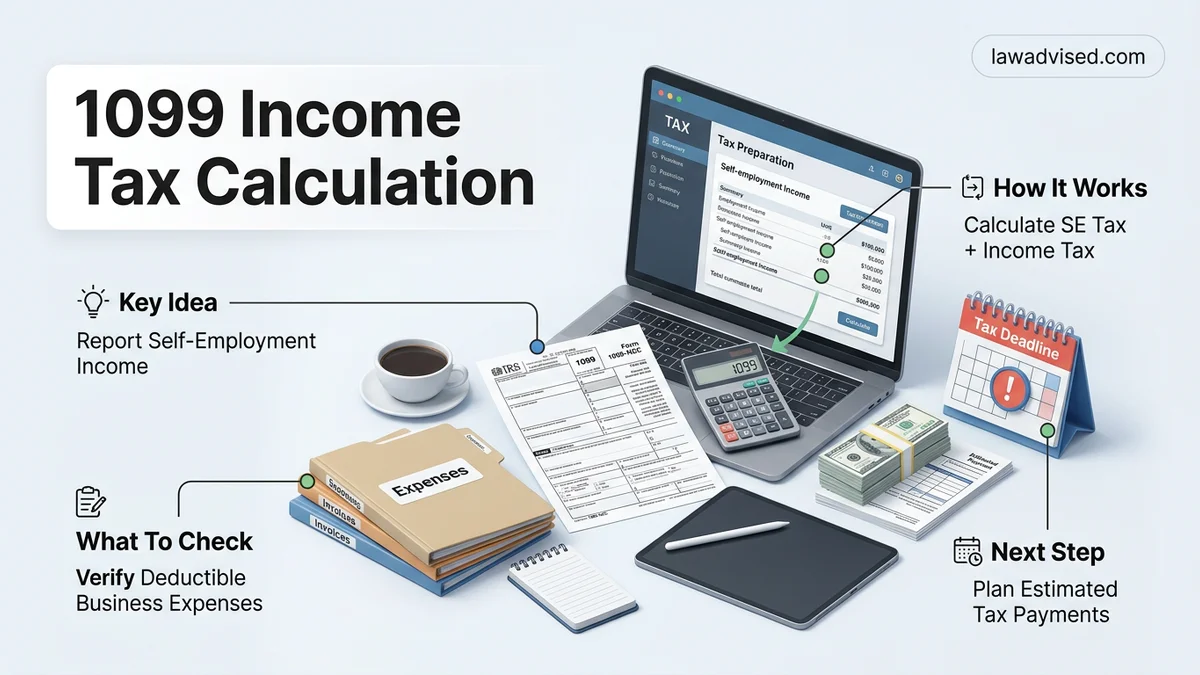
Calculating 1099 income tax requires accounting for both self-employment tax and federal income tax. Independent contractors must first subtract business expenses from gross income to find net profit before running the tax calculations.
Calculating your 1099 income taxes for 2026 requires determining your net profit, paying the 15.3% self-employment tax, and calculating your federal income tax based on your tax bracket. Unlike W-2 employees who have taxes automatically deducted from every paycheck, independent contractors must manage their own tax liabilities from scratch.
Mastering this calculation prevents costly surprises and IRS penalties during the 2026 tax season. By following a structured math formula—Gross Income minus Deductions equals Net Profit—you can accurately project what you owe and keep your business financially healthy.
Key Takeaways
- Subtract valid business expenses from gross income to determine your net profit.
- Calculate self-employment tax at 15.3% on 92.35% of your net earnings.
- Deduct half of your self-employment tax from your adjusted gross income.
- Pay quarterly estimated taxes if you expect to owe more than $1,000.
- File Schedule C, Schedule SE, and Form 1040 to report your earnings.
Why 1099 Income Tax Calculation Confuses Independent Contractors
The W-2 vs. 1099 Tax Burden Shock
When you transition to freelance work, the biggest shock is realizing you pay the full 15.3% for Social Security and Medicare taxes. Your traditional employer normally pays half of this FICA tax, but as a 1099 worker, you shoulder the entire burden via Schedule SE.
Social Security portion: 12.4% applies up to the 2026 wage base limit.
Medicare portion: 2.9% applies to all earnings without a cap.
Additional tax: High earners may face an extra 0.9% Medicare tax on net earnings above specific thresholds.
Missing the Estimated Tax Payment Window
Because no taxes are withheld from your client payments, the IRS expects you to pay as you go through quarterly estimated tax payments. Waiting until April 2027 to calculate and pay your entire 2026 tax liability triggers underpayment penalties and severe cash flow crunches.
How to Calculate Net Profit Using Schedule C Deductions
Tallying Your Gross 1099 Revenue
Your calculation begins with your gross income, which is the total amount clients paid you during the 2026 calendar year. Gather all your Form 1099-NEC documents, bank statements, and direct payment platform records to ensure your baseline revenue figure is completely accurate.
Writing Off Business Expenses to Lower Taxable Income
Next, you subtract all ordinary and necessary business expenses on Schedule C to find your true net profit. Every legitimate write-off directly reduces the amount of income subject to both self-employment tax and federal income tax.
Home office deduction: Write off a proportional percentage of your rent, utilities, and internet based on square footage.
Vehicle and travel costs: Deduct business miles driven using the standard IRS mileage rate for 2026.
Software and equipment: Fully deduct computers, subscriptions, and tools used exclusively for your contracting work.
Step-by-Step Formula for Self-Employment and Income Taxes
Calculating your 2026 independent contractor liability requires a sequential approach to ensure accurate payments to the IRS and state agencies. According to guidelines from the National Association of Tax Professionals (NATP), independent workers must separate business profits from personal adjusted gross income before applying tax rates.
Calculating Your Net Earnings
- Compile all 1099-NEC and 1099-K forms received for the 2026 tax year alongside records of cash and direct client payments.
- Subtract all ordinary and necessary business expenses tracked on your Schedule C from your total gross receipts.
- Multiply your net business profit by 92.35 percent to determine your net earnings subject to self-employment tax.
Applying Tax Rates and Deductions
- Multiply your net earnings figure by 15.3 percent to find your total Social Security and Medicare self-employment tax liability.
- Subtract exactly half of your calculated self-employment tax from your net profit to find your adjusted gross income baseline.
- Apply the 2026 federal income tax bracket rates corresponding to your filing status and taxable income level.
What to Do If You Owe More Than Expected in 2026
Discovering a massive tax liability after running your calculations can cause immediate financial stress. Financial planners emphasize that ignoring a tax bill compounds the issue rapidly through statutory interest and failure-to-pay penalties assessed by the IRS.
Immediate Action Steps
- File your return or extension on time by the April 2027 deadline to avoid the much steeper failure-to-file penalty, which costs five percent of unpaid taxes monthly.
- Apply for an IRS Short-Term Payment Plan online if you need up to 180 days to clear your balance in full without formal installment setup fees.
- Establish an IRS Installment Agreement for monthly payments up to 72 months, noting that setup fees range from 31 dollars for direct debit to 130 dollars for standard arrangements.
What If It Still Doesn’t Work?
If manual calculations yield conflicting results or your automated tax software triggers persistent validation errors, fallback measures are necessary. Complex business structures, multi-state income, or high-bracket thresholds often outpace standard DIY tax applications.
- Switch to a certified public accountant (CPA) or an Enrolled Agent (EA) who specializes in freelance and small-business taxation. Professional preparation fees for a Schedule C filer generally range from 300 dollars to 750 dollars depending on complexity and bookkeeping readiness.
- Request a formal wage and income transcript directly from the IRS online portal to verify that all third-party reporting matches your internal records.
- Contact the IRS Taxpayer Assistance Center or utilize the IRS Volunteer Income Tax Assistance (VITA) program if you meet qualifying income thresholds for free expert guidance.
Conclusion
Mastering your 1099 income tax calculation prevents costly surprises and protects your independent business from severe regulatory penalties. By systematically tracking expenses, withholding the correct percentage for self-employment tax, and submitting quarterly estimates, you maintain total financial control. According to verified research and tax experts, proactive planning remains the single most effective method for minimizing freelancer liability. Take your next actionable step today by opening a dedicated business ledger to log all current year deductions.
❓ Frequently Asked Questions
How do I calculate self-employment tax step-by-step?
Multiply your net self-employment earnings by 92.35%, then multiply that subtotal by the 15.3% tax rate to find your total self-employment tax liability.
What is the purpose of the self-employment tax deduction?
The IRS allows you to deduct half of your calculated self-employment tax from your gross income to lower your federal income tax burden, mirroring the employer share of FICA taxes.
Are 1099 workers required to pay state income tax?
Yes, unless your state has no state income tax. You must calculate and pay state and local estimated taxes quarterly in addition to federal obligations.
What happens if I miss a quarterly estimated tax payment?
The IRS may charge you an underpayment penalty and interest on the unpaid amount when you file your annual tax return.
How do business write-offs lower my 1099 tax liability?
Business write-offs directly reduce your gross receipts to a lower net profit figure, meaning you pay self-employment and income tax on a smaller total amount.
Do I need to file a tax return if my 1099 income was very low?
If your net earnings from self-employment were $400 or more, you are legally required to file a federal income tax return and pay self-employment tax, even if you owe no income tax.

Ismail Hossain is the founder of Law Advised. He is an Divorce, Separation, marriage lawyer. Follow him.