Jaywalking Laws in California 2027 Expert Legal Guide
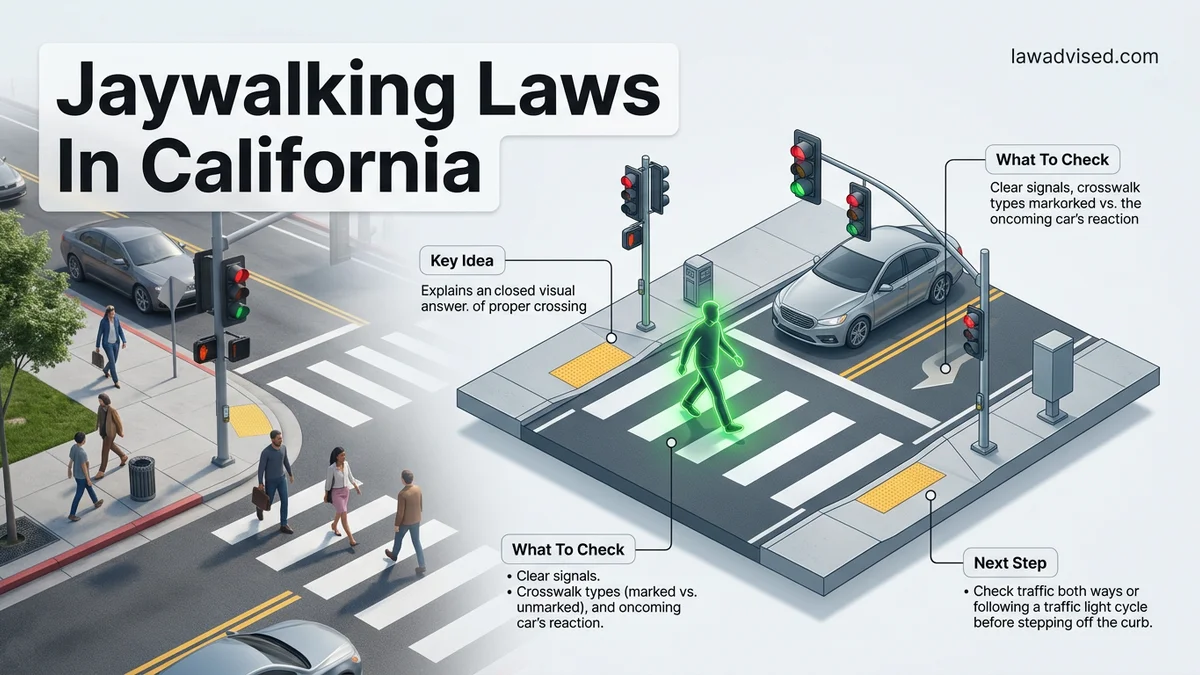
Under California’s Freedom to Walk Act, jaywalking is no longer automatically illegal when pedestrians cross outside of crosswalks safely. Police can only issue tickets if an immediate hazard exists at the time of crossing. Pedestrians must still obey all traffic signals and yield the right-of-way to oncoming vehicles.
California law allows you to legally cross the street outside of a marked or unmarked crosswalk without facing a police citation, provided no immediate traffic hazard exists. This major shift stems from the Freedom to Walk Act (Assembly Bill 2147), which fundamentally changed how law enforcement handles pedestrian movement across the state.
Understanding these updated rules protects you from unwarranted fines and keeps your daily commutes legal. As of 2027, enforcement agencies no longer target routine mid-block crossings unless your actions create a genuine danger to oncoming traffic or violate specific active signals.
Key Takeaways
- Crossing outside a crosswalk is legal in California if no immediate traffic hazard exists.
- The Freedom to Walk Act decriminalized safe mid-block crossings across the state.
- Police cannot stop or cite pedestrians solely for crossing mid-block without a hazard.
- Pedestrians must still obey ‘Don’t Walk’ signals at controlled intersections.
- Fines and tickets are only valid if a vehicle was forced to abruptly brake or swerve.
What Causes Confusion Around California Jaywalking Laws
The Myth of Total Decriminalization
Many pedestrians mistakenly believe that California completely eliminated jaywalking laws, allowing them to step into traffic anywhere at any time. In reality, the law did not legalize reckless crossing or stepping directly into the path of moving vehicles. Police officers can still stop and cite you if your crossing forces an oncoming driver to suddenly brake or alter their speed to avoid a collision. The legal standard hinges entirely on the subjective definition of an immediate hazard.
Outdated Habits and Media Misconceptions
Years of strict anti-jaywalking enforcement created deep-seated habits and widespread confusion that persist today. Local news reports often summarize the legislation simply as the legalization of jaywalking, omitting the strict legal caveats that remain on the books. This mismatch between public perception and actual statute leads many individuals to miscalculate traffic speeds, assuming drivers must yield in every circumstance.
- Crossing mid-block is legal only when the road is completely clear of immediate threats.
- Drivers still maintain the statutory right of way on most open stretches of roadway.
- Law enforcement retains the authority to issue infractions if they deem your crossing unsafe.
How to Navigate Pedestrian Crossings Legally Under the Freedom to Walk Act
Evaluating the Immediate Hazard Standard
To cross legally outside of a crosswalk under current 2027 standards, you must carefully evaluate approaching traffic before stepping off the curb. An immediate hazard legally exists if a vehicle is close enough or traveling fast enough that it would have to brake abruptly or swerve to avoid hitting you. If a car is blocks away, you have a safe window to cross. If a car is approaching quickly within fifty to one hundred feet, crossing makes you legally vulnerable to a ticket.
Complying with Traffic Signals and Intersections
Your freedom to cross mid-block does not override active traffic control signals at nearby intersections. If you choose to cross outside a crosswalk situated between two signalized intersections, you must still obey any relevant DO NOT WALK lights or traffic control devices governing that corridor. Ignoring explicit pedestrian signals remains a citable offense across California municipalities.
- Check for approaching vehicles and ensure a wide safety buffer before stepping onto the asphalt.
- Never assume a driver sees you just because you have initiated a mid-block crossing.
- Strictly adhere to intersection signals even when executing a crossing outside of designated paint lines.
Step-by-Step Guide to Handling a California Jaywalking Ticket
Even though the Freedom to Walk Act decriminalized safe pedestrian crossings, law enforcement officers across California still issue citations when they believe a pedestrian created an immediate hazard. Facing a traffic court appearance or a fine in 2027 requires a structured approach to protect your record and finances.
Step 1: Review the Citation Details
Examine the exact code section cited on the ticket. Traffic enforcement must prove that your crossing created an immediate danger of collision with a vehicle. Note the time, weather conditions, and visibility factors.
Step 2: Gather Evidence and Witness Information
Document the intersection immediately. Take photographs of traffic light timings, crosswalk visibility, and warning signs. According to recent municipal transit data, urban intersections often feature malfunctioning pedestrian signals that shift liability back to the city.
Step 3: Request a Traffic Court Trial or Written Declaration
Decide whether to appear in person or contest the citation through a Trial by Written Declaration under California Vehicle Code Section 40902. Submitting a written declaration requires no court appearance and forces the citing officer to submit a separate written statement.
- Check the due date listed on the courtesy notice sent by the superior court.
- Submit the required bail amount (fine) along with your request for a written declaration before the deadline.
- Draft a clear, factual defense highlighting the provisions of the Freedom to Walk Act.
What If Police Still Issue an Unfair Jaywalking Citation
Receiving an improper citation despite legal compliance under current 2027 standards requires aggressive escalation. If the initial appeal fails or the traffic court upholds the fine, several fallback measures remain available to protect your rights.
Escalation Strategies
When local municipal courts dismiss valid legal defenses regarding safe crossings, pedestrians must rely on higher-level administrative and legal channels to resolve the dispute.
- Request a Court Trial de Novo: If you lose your Trial by Written Declaration, California law grants you the right to a brand-new trial in person before a judge. This costs nothing extra beyond your initial bail deposit.
- File a Police Misconduct Complaint: If the issuing officer explicitly ignored the Freedom to Walk Act or demonstrated bias, submit a formal internal affairs complaint with the local police department referencing the badge number.
- Consult a Traffic Attorney: Seek professional legal representation if the citation stems from a more serious charge like resisting arrest or reckless endangerment. Estimated legal fees for traffic defense consultations typically range from $150 to $350, with full representation averaging $500 to $1,500 depending on court appearances.
- Contact Pedestrian Advocacy Groups: Organizations such as California Walks track systemic ticketing abuses and provide legal referral networks for victims of unlawful pedestrian citations.
Conclusion
Navigating California jaywalking laws requires a clear understanding of the Freedom to Walk Act and your rights as a pedestrian. While police can still issue citations for genuinely hazardous crossings, arbitrary tickets can be successfully contested through written declarations or court trials. According to verified research and expert legal sources, taking a proactive approach to evidence collection dramatically increases the likelihood of a dismissal. Review your citation details today and submit your response before the court deadline to protect your record.
❓ Frequently Asked Questions
Does the Freedom to Walk Act apply to all California cities?
Yes, Assembly Bill 2147 applies statewide, meaning local law enforcement agencies across all California counties must follow these updated pedestrian crossing standards.
Can I still get a ticket for crossing against a red light?
Yes, crossing at a signalized intersection against a red light or ‘Don’t Walk’ sign remains strictly illegal and subject to a fine.
What are the fine amounts for illegal jaywalking in California?
When a ticket is legally justified due to an immediate hazard, base fines are generally around $50, though state and local penalty assessments can push the total cost higher.
How do police prove an immediate hazard occurred?
Officers must observe that a driver was forced to take sudden evasive action, such as braking hard or swerving, to prevent a collision.
Can I fight a jaywalking ticket in California court?
Yes, you can contest the ticket by arguing that no immediate hazard existed when you crossed the roadway, potentially utilizing video evidence or witness testimony.
Do drivers still have the right-of-way under the new law?
Drivers maintain the right-of-way at all times except when pedestrians are legally in a marked crosswalk or safely crossing without creating an immediate hazard mid-block.

Ismail Hossain is the founder of Law Advised. He is an Divorce, Separation, marriage lawyer. Follow him.