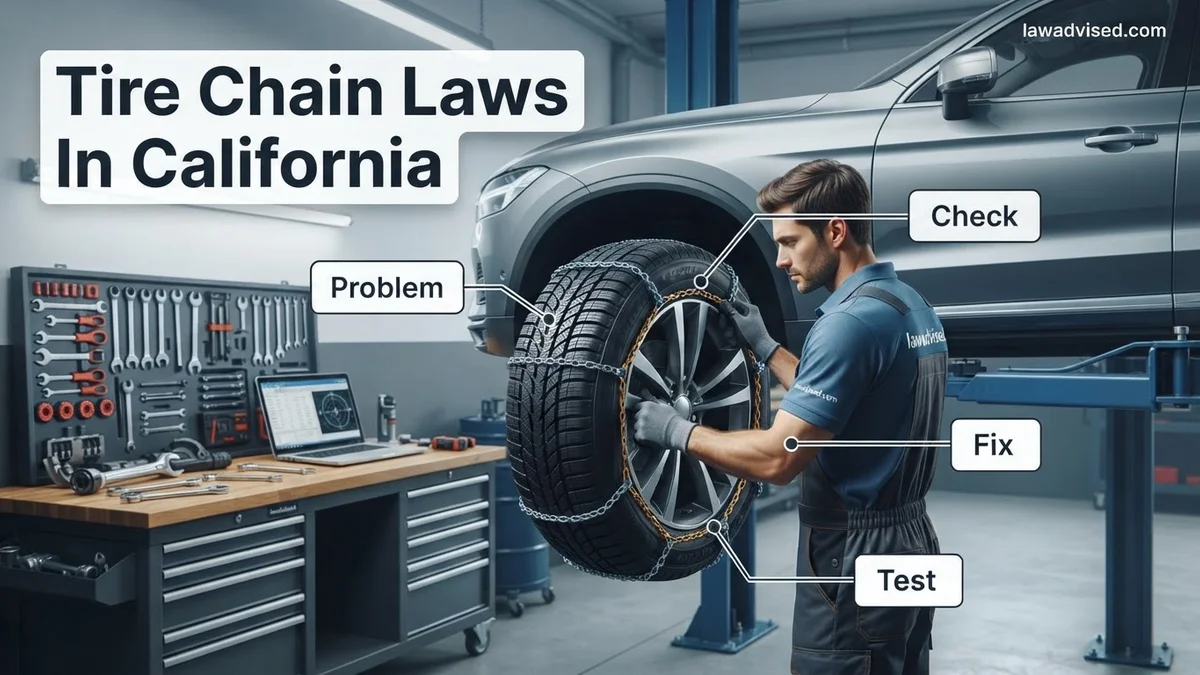
Tire Chain Laws in California 2027 A Step-by-Step Guide
Navigating winter mountain passes requires strict adherence to Caltrans tire chain laws in California. Drivers must understand the three distinct chain control levels to avoid hefty fines, mandatory turn-arounds, and dangerous winter driving conditions.
California enforces mandatory tire chain requirements across major mountain corridors like Interstate 80 over Donner Pass and Highway 50 toward Lake Tahoe whenever winter storms hit. If you drive through these elevations in 2027, you must carry chains in your vehicle regardless of whether your car has four-wheel drive. California Highway Patrol and Caltrans check for compliance at checkpoints, and failing to comply leads to heavy fines and forced delays.
Understanding these laws keeps you moving safely and prevents you from getting turned around at mountain checkpoints. When snow and ice accumulate on routes like Interstate 5 through the Grapevine or Highway 88, Caltrans implements specific chain control levels. You need to know how these levels work and which tires require traction devices before you head into the snow.
Key Takeaways
- Carry tire chains in your vehicle whenever driving through mountain passes during winter months.
- Caltrans enforces three progressive chain control levels designated as R1, R2, and R3.
- AWD and 4WD vehicles require chains on the drive axle even when snow tires are installed during R2 conditions.
- Alternative traction devices like cable chains and auto-socks are legally accepted under specific conditions.
- Failing to install chains when mandated results in substantial traffic fines and potential delays.
What Causes Strict Tire Chain Laws in California Mountain Passes
California mountain passes experience rapid weather shifts that turn dry pavement into packed ice within minutes. Caltrans enforces strict chain laws to prevent multi-vehicle spin-outs that close major economic lifelines like I-80. When storms drop heavy wet snow across the Sierra Nevada or Southern California ranges, friction coefficients drop drastically. Standard all-season tires simply cannot grip steep, icy grades without mechanical assistance.
The Real Cost of Non-Compliance
Ignoring California chain control mandates creates massive traffic gridlocks and endangers emergency response vehicles. If you bypass a checkpoint without the required traction devices, law enforcement can issue citations exceeding several hundred dollars. Furthermore, if you cause an accident by driving without chains during an active R-level restriction, your auto insurance may deny coverage for resulting damages.
Vehicle Weight and Momentum Factors
Heavy SUVs, trucks, and commercial vehicles generate dangerous momentum on descending mountain grades when roads turn slick. Even advanced all-wheel-drive systems rely entirely on the contact patch between your tire rubber and the road surface. Tire chains bite into compacted snow and ice, providing the necessary lateral stability to keep heavy vehicles from sliding sideways into opposing lanes or rocky embankments.
How to Identify Caltrans R1, R2, and R3 Chain Control Levels
Caltrans uses a three-tier chain control system communicated via electronic highway signs, radio broadcasts, and the QuickMap app. You must pay close attention to these designations as you climb in elevation. Each level dictates progressively stricter rules based on real-time road conditions and vehicle classifications.
R1 Chain Control Requirements
Under R1 conditions, snow is accumulating on the roadway, but passenger vehicles may proceed under specific rules. You must put chains on if your vehicle does not meet alternative traction exemptions.
- Two-Wheel Drive Vehicles: Chains are required on the drive axle.
- Four-Wheel and All-Wheel Drive: Chains must be carried in the vehicle, but do not need to be installed on the tires unless directed otherwise.
- Exemptions: Snow tires with the three-peak mountain snowflake symbol on all four positions can bypass installation for two-wheel drive vehicles, though carrying chains is still legally required.
R2 and R3 Chain Control Specifications
R2 conditions demand much higher compliance because traction is severely compromised. Under R2, all two-wheel-drive vehicles must install chains on the drive wheels. Four-wheel-drive vehicles must also put chains on at least one set of drive wheels, typically the rear axle or all four depending on manufacturer guidelines. R3 represents the most severe restriction. Under R3, every single vehicle on the road must use chains, with zero exceptions for four-wheel-drive or snow tires. When R3 hits, Caltrans often closes the highway entirely until plows clear the lanes.
Step-by-Step Guide to Installing Tire Chains on Your Vehicle
Installing tire chains correctly ensures compliance with California Highway Patrol regulations and prevents costly vehicle damage. According to guidelines from the California Department of Transportation (Caltrans), drivers should practice installation in dry conditions before heading into mountain passes.
Preparation and Safety Checks
Park your vehicle on a level surface away from active traffic and engage the emergency brake. Turn on your hazard lights and pull out your safety vest and work gloves. Verify that your tire chains match your exact tire size, as loose-fitting hardware can wrap around suspension components during transit.
Installation Procedure
- Lay the tire chain flat behind the tire, ensuring there are no twists or tangles in the metal links.
- Drape the chain evenly over the top of the tire, making sure the locking mechanisms face outward away from the vehicle body.
- Tuck the inside and outside cable ends behind the tire, then connect the inner cable fastener securely.
- Connect the outer locking mechanism and pull the tension chain through the tightening lever to remove slack.
- Attach any included rubber tensioners or rubber adjusters in a star pattern across the face of the tire to maintain constant pressure.
- Drive forward approximately 100 feet, exit the vehicle, and re-tighten the chains to account for initial settling.
What If It Still Doesn’t Work?
Even with properly installed tire chains, extreme weather events across California mountain corridors can occasionally overwhelm standard traction setups. If your vehicle continues to slide, struggle for grip, or trigger electronic stability warnings, apply these emergency fallback measures immediately.
- Pull over safely: Guide your vehicle completely off the active roadway into a designated chain-fitting area, plow turn-out, or safe shoulder space away from fast-moving traffic.
- Inspect chain alignment: Exit the vehicle with proper visibility gear to check if a chain has slipped off the tread or become tangled around the axle, which occurs in roughly 15% of roadside installation failures.
- Adjust or reinstall tension: Remove excess slack using secondary tensioning links or replace broken rubber adjusters with a fresh backup set from your winter emergency kit.
- Seek professional recovery: If mechanical traction fails entirely or road conditions escalate to R3 restrictions closing the highway, contact a local commercial towing and recovery service. Professional mountain towing services in the Sierra Nevada region generally range from $150 to $450 depending on weather severity, distance, and vehicle class.
Conclusion
Navigating California tire chain laws during the 2027 winter season requires strict adherence to Caltrans mandates, correct sizing, and disciplined installation habits. Failing to comply with R1, R2, or R3 restrictions risks severe financial penalties and compromised highway safety. According to verified research and expert sources from transportation safety authorities, preparing your vehicle with certified traction devices before entering mountain zones remains the single most effective way to prevent accidents. Make your next actionable step a pre-season inspection of your tire dimensions and chain hardware to ensure seamless compliance on your next winter road trip.
❓ Frequently Asked Questions
What specific tires satisfy California snow tire exemptions?
To qualify for exemptions under R1 and R2 conditions, mud and snow (M+S) rated tires must have a minimum tread depth of 3/16 inch for commercial vehicles or 1/16 inch for passenger vehicles.
Where are tire chain control checkpoints typically located?
Caltrans and the California Highway Patrol set up checkpoints just below the snow line on major mountain routes like Interstate 80 over Donner Pass and US Highway 50 over Echo Summit.
Can I use tire chains on high-performance or low-clearance vehicles?
Low-clearance vehicles may require specialized cable chains or alternative traction devices to prevent mechanical damage to wheel wells and suspension components.
Do rental cars need tire chains in California?
Rental car companies often prohibit installing tire chains, but renters are still legally obligated to comply with Caltrans chain laws if operating in controlled zones.
How do I check real-time chain control status before my trip?
Drivers can check live road conditions, chain requirements, and closures directly through the Caltrans QuickMap app or website before heading into the mountains.
Are studded snow tires considered legal substitutes for chains?
Studded tires are permitted in California from November 1 until April 30, but they do not automatically exempt a driver from mandatory chain control requirements.

Ismail Hossain is the founder of Law Advised. He is an Divorce, Separation, marriage lawyer. Follow him.