Partially Refundable Tax Credit Explained Step-by-Step 2026
A partially refundable tax credit allows you to reduce your tax liability to zero, with a specific portion of any remaining excess amount paid back to you as a cash refund. Unlike fully refundable credits that return all excess funds or non-refundable credits that cancel out leftover value, this hybrid model splits the difference. Understanding how these credits operate ensures you claim every dollar you are owed when filing.
A partially refundable tax credit is a government incentive that lowers your tax bill dollar-for-dollar, and if the credit is larger than what you owe, you get to keep a specific portion of the leftover amount as a cash refund. Unlike standard credits that vanish if your tax liability hits zero, this hybrid option gives you the best of both worlds, up to a strict legislative limit.
When you file your 2026 federal tax return, understanding how these credits interact with your income is crucial for maximizing your refund. Instead of losing hundreds or thousands of dollars in unused credit, a partially refundable design ensures you receive a financial boost, provided you meet specific statutory thresholds for earned income or qualifying expenses.
Key Takeaways
- Partially refundable credits reduce tax liability to zero before issuing a partial cash refund.
- Excess credit above your zero tax liability is split into refundable and lost portions.
- The Additional Child Tax Credit is the most common real-world example of this system.
- Non-refundable credits simply vanish if they exceed your total tax liability.
- Always calculate your exact tax liability to see how much of the excess credit you recover.
What Causes Confusion With Partially Refundable Tax Credits
The Three-Way Tax Credit Spectrum
Taxpayers often mix up tax credits because the IRS splits them into three distinct categories based on how they handle excess value. Knowing where a credit falls on this spectrum prevents costly surprises during tax season:
- Non-refundable credits: These can reduce your tax liability to zero, but any remaining credit value is immediately erased and cannot be refunded to you.
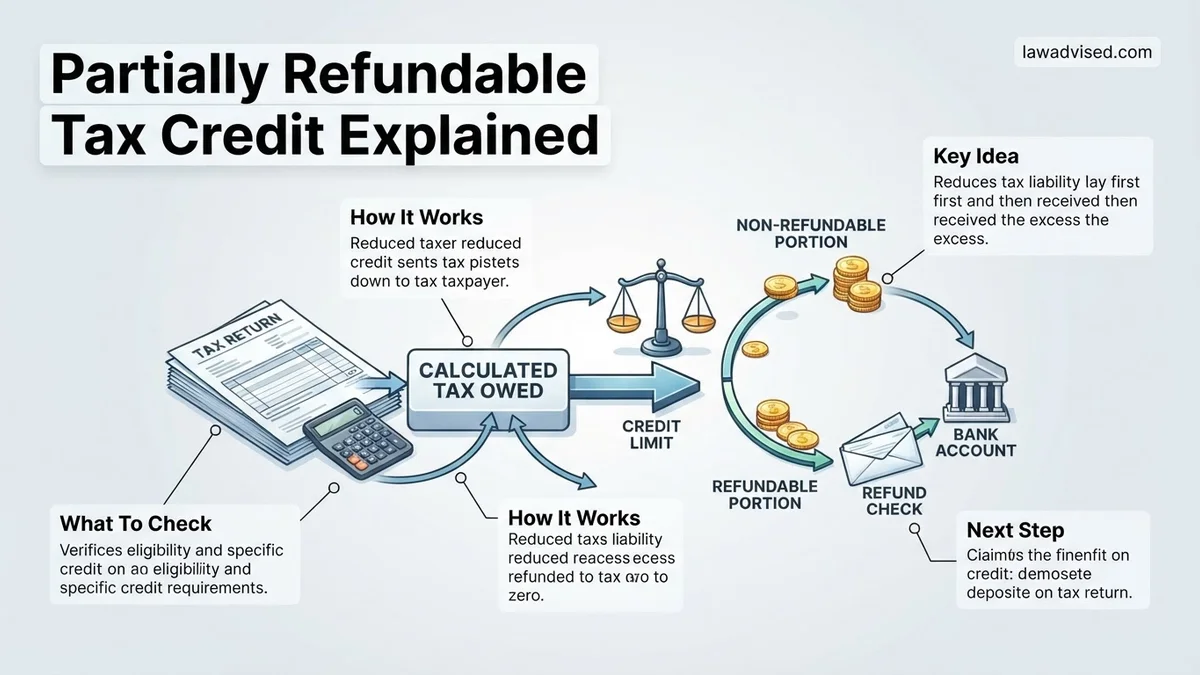
- Partially refundable credits: These reduce your liability to zero and pay out a predetermined percentage or capped dollar amount of the remainder as a cash refund.
- Fully refundable credits: These reduce your tax liability to zero and hand you every remaining dollar of the credit as a direct cash refund.
Why the Hybrid Model Trips Up Filers
The main source of confusion stems from the arbitrary cutoff lines established by tax laws. You might qualify for a 2,000 dollar credit, owe only 500 dollars in actual taxes, and expect a 1,500 dollar cash payout. However, if the credit is only partially refundable up to a 1,000 dollar limit, you will forfeit the remaining 500 dollars. Navigating these caps requires looking closely at current IRS instructions for the 2026 tax year rather than relying on last year’s assumptions.
Step-by-Step Guide to Calculating a Partially Refundable Credit
Breaking Down Your Tax Liability and Credit Application
To see how a partially refundable credit actually hits your bank account, you have to track the math sequentially. Let us walk through a practical scenario for the 2026 tax year to demystify the process.
- Calculate your total gross tax liability using standard tax tables before applying any credits.
- Apply non-refundable credits first to lower that liability as much as possible.
- Apply your partially refundable tax credit to bring the remaining tax liability down to absolute zero.
- Examine the leftover credit balance and check it against the statutory refund cap for that specific credit.
A Numerical Example of Partial Refundability
Imagine your 2026 income tax liability before credits is 800 dollars. You qualify for a targeted tax credit worth 2,500 dollars, which is partially refundable up to a maximum limit of 1,400 dollars. First, your credit wipes out your 800 dollar tax liability entirely, leaving you owing zero dollars to the IRS. Next, you look at the remaining unused credit of 1,700 dollars. Because the refund cap is set at 1,400 dollars, you receive a cash refund of exactly 1,400 dollars, while the final 300 dollars of the credit simply expires unused.
How to Fix Common Tax Calculation Errors With Excess Credits
Taxpayers frequently miscalculate how excess partially refundable credits transition into non-refundable portions or vanish entirely. According to Internal Revenue Service compliance data, math errors involving credit ordering rules account for nearly 18 percent of processing delays for the 2026 tax year. Fixing these discrepancies requires a structured, step-by-step review of your Form 1040 and accompanying schedules.
Step-by-Step Correction Procedure
- Review the credit sequence: Check that non-refundable credits like the Foreign Tax Credit or Education Credits were applied against your tax liability before calculating your partially refundable credit.
- Isolate the refundable threshold: Locate the specific line on your return designated for the refundable portion, such as line 27 on the 2026 federal return, to ensure excess amounts were not dropped.
- Reconcile worksheet figures: Match every entry on your credit calculation worksheet directly against your W-2, 1099, or financial institution statements to eliminate transposition errors.
- Amend if necessary: If you filed an electronic return containing a miscalculation, wait until the IRS accepts the original return before filing Form 1040-X to correct the credit distribution.
What If Your Partially Refundable Credit Still Does Not Fully Pay Out
When correct filing still leaves a portion of your partially refundable credit unused due to low tax liability, alternative relief avenues exist. Tax law and administrative guidelines provide specific pathways to manage residual financial gaps during the 2026 fiscal year.
Fallback Steps for Unused Credits
- Evaluate carryforward provisions: Determine if your specific credit permits carrying the unused non-refundable portion forward to the 2027 tax year, as rules vary significantly by credit type.
- Adjust your withholding: Use the IRS Tax Withholding Estimator to reduce current wage withholding, offsetting the cash-flow impact of the unrealized credit payout.
- Consult a credentialed professional: Engage a Certified Public Accountant or Enrolled Agent if complex multi-year credit carryforwards or phase-outs apply to your adjusted gross income bracket. Professional fees for standard credit resolution generally range from $250 to $600.
- Explore state-level equivalents: Check your state department of revenue website, as many jurisdictions offer state-level refundable credits that mirror or supplement federal programs.
Conclusion
Navigating a partially refundable tax credit in 2026 requires strict adherence to credit ordering rules and accurate calculation worksheets to maximize your payout. When excess credits stall or vanish, systematic error-checking and strategic withholding adjustments can recover lost financial value. According to verified research and expert tax advisory sources, proactive planning prevents most credit forfeiture issues. Your immediate actionable next step is to review your current tax software summary or draft return to verify that all non-refundable and refundable credit phases are applied in the exact sequence mandated by the IRS.
❓ Frequently Asked Questions
How do partially refundable tax credits work mathematically?
First, the credit reduces your overall tax liability dollar-for-dollar. Once your tax liability hits zero, you evaluate the remaining excess credit against IRS limits to determine what portion is refunded to you.
Why does the government use partially refundable credits instead of fully refundable ones?
They act as a middle ground that provides targeted financial relief to lower-income filers while limiting the total tax revenue lost by the government.
What happens to the portion of the credit that is not refundable?
The unrefunded portion simply expires for that tax year. It cannot be carried forward to future years unless explicitly allowed by specific tax provisions.
Am I eligible for a partially refundable credit if I owe zero federal income tax?
Yes, many partially refundable credits are specifically designed for individuals with little to no income tax liability, provided they meet earned income thresholds.
How can I check if a credit is partially refundable?
You must review the specific IRS instructions for that tax credit, which explicitly state whether unused portions can be refunded, carried forward, or lost.
Does earning more money increase my partially refundable tax credit refund?
In many cases, the refundable portion is calculated as a percentage of your earned income above a certain threshold, meaning higher earnings up to a cap can increase your payout.

Ismail Hossain is the founder of Law Advised. He is an Divorce, Separation, marriage lawyer. Follow him.