Taxes on Mutual Fund Distributions Expert Guide for 2026
Investors must pay taxes on mutual fund distributions even if they automatically reinvest dividends and capital gains into more shares. Understanding the difference between short-term and long-term gains, alongside qualified dividends, is essential for lowering your annual tax bill. Strategic placement in tax-advantaged accounts effectively shields your portfolio from these recurring liabilities.
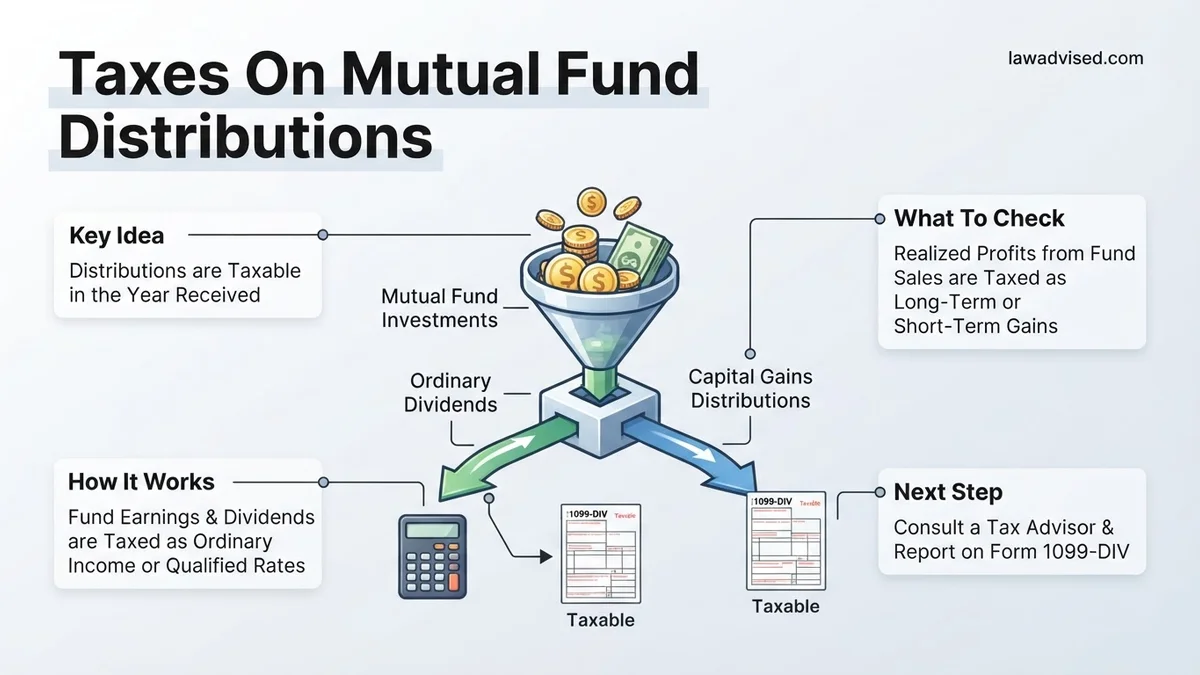
Mutual fund distributions are taxed in the year they are issued, regardless of whether you cash them out or automatically reinvest them into more shares. You will owe taxes on two primary types of payouts: capital gains distributions (triggered when the fund manager sells underlying securities for a profit) and dividend distributions (payouts from the income generated by the fund’s holdings). Because mutual funds are pass-through entities, any internal trading activity by the fund manager directly impacts your personal tax liability.
Managing these tax obligations effectively prevents surprise bills during the 2026 tax season. When you hold mutual funds in a taxable brokerage account, you cannot defer these taxes like you can in a 401(k) or IRA. Understanding how these distributions are categorized, calculated, and taxed allows you to optimize your portfolio and keep more of your investment returns.
Key Takeaways
- Mutual fund distributions trigger taxable events even when automatically reinvested.
- Short-term capital gains are taxed as ordinary income rates.
- Long-term capital gains benefit from lower preferential tax rates.
- Reinvested distributions increase your cost basis, reducing future capital gains.
- Holding funds in retirement accounts defers taxes on all distributions.
What Causes Taxes on Mutual Fund Distributions
Internal Portfolio Trading and Capital Gains
Every time a fund manager sells a stock or bond for more than its purchase price, a capital gain is realized inside the fund. By law, mutual funds must distribute these realized net capital gains to shareholders at least annually, usually in November or December. Even if your fund’s overall value dropped during the year, you can still receive a capital gains distribution if the manager sold underlying assets at a profit earlier in the period.
-
Key drivers of fund-level capital gains:
- High portfolio turnover where stocks are bought and sold frequently
- Heavy shareholder redemptions forcing the manager to sell securities to raise cash
- Bull market conditions resulting in widespread profitable asset sales
Dividend and Interest Income Payouts
Beyond capital gains, mutual funds collect dividends from stocks and interest from bonds held within the portfolio. These earnings are passed directly to you as dividend distributions. Depending on the source of the income, these payouts are classified as either qualified dividends (taxed at preferential long-term capital gains rates) or ordinary dividends (taxed at your higher ordinary income tax rate).
-
Common sources of fund income:
- Corporate stock dividends distributed quarterly or annually
- Interest payments from corporate, municipal, or treasury bond funds
- Real estate investment trust (REIT) distributions often classified as ordinary income
Step-by-Step Guide to Calculating Capital Gains and Dividends
Short-Term Versus Long-Term Capital Gains
When your mutual fund issues a capital gains distribution, it is split into short-term and long-term buckets based on how long the fund held the underlying security, not how long you have owned the fund. Short-term capital gains apply to assets held by the fund for one year or less, and they are taxed at your ordinary income tax bracket for 2026. Long-term capital gains apply to assets held for more than one year, benefiting from preferential 2026 tax rates of 0%, 15%, or 20% depending on your taxable income.
-
How to determine your taxable gain:
- Locate Form 1099-DIV issued by your brokerage firm at the beginning of the year.
- Check Box 2a for total capital gains distributions and Box 2b for unrecaptured section 1250 gain or collectibles.
- Multiply your short-term gains (reported on supplemental statements) by your marginal income tax bracket.
- Multiply your long-term capital gains by your applicable long-term capital gains tax rate for 2026.
Calculating Tax on Qualified Versus Ordinary Dividends
Dividend distributions require a similar calculation step. Ordinary dividends are added directly to your wages and salary, taxing them at your standard federal income tax bracket. Qualified dividends qualify for the lower long-term capital gains rates, provided you met the holding period requirement of owning the mutual fund shares for more than 60 days during the 121-day window surrounding the ex-dividend date.
-
Steps for dividend tax calculation:
- Identify ordinary dividends listed in Box 1a of your Form 1099-DIV.
- Identify qualified dividends listed in Box 1b (which is a subset of Box 1a).
- Apply ordinary income tax rates to the non-qualified portion.
- Apply the 0%, 15%, or 20% rate to the qualified dividend portion based on your 2026 filing status and income level.
Proven Strategies to Minimize Mutual Fund Taxes
Minimizing taxes on mutual fund distributions requires proactive portfolio management. According to data from the Investment Company Institute, proactive tax-loss harvesting and asset placement can significantly lower an investor’s annual tax liability in taxable accounts.
1. Utilize Tax-Advantaged Accounts
The easiest way to avoid mutual fund distribution taxes is to hold your funds in tax-advantaged accounts like traditional IRAs, Roth IRAs, or 401(k) plans. Inside these accounts, capital gains distributions and dividends grow tax-deferred or completely tax-free, eliminating year-end tax surprises for 2026.
2. Pivot to Tax-Managed Funds
If you must hold mutual funds in a taxable brokerage account, select options specifically labeled as tax-managed funds. Portfolio managers of these funds actively minimize realized capital gains by offsetting winners with losers throughout the year, limiting the size of December distributions.
3. Embrace Exchange-Traded Funds (ETFs)
ETFs generally feature superior tax efficiency compared to traditional mutual funds. Because of their unique in-kind creation and redemption mechanism managed by authorized participants, ETFs rarely distribute capital gains to individual shareholders.
What If Your Distributions Still Create an Unexpected Tax Bill
Even with careful planning, a sudden market downturn or heavy fund redemptions can trigger a massive capital gains distribution. If your 2026 distribution taxes exceed your expectations, take immediate corrective action to mitigate the financial damage.
- Execute tax-loss harvesting: Sell underperforming individual stocks or assets in your taxable portfolio before December 31 to offset the capital gains distributed by your mutual funds.
- Adjust your W-4 withholding: If you realize a large distribution is coming, increase your workplace withholding immediately to cover the expected tax liability and avoid underpayment penalties.
- Consult a certified financial planner or CPA: For complex portfolios with heavy distribution impacts, professional guidance is essential. Hiring a CPA or CFP typically costs between $200 and $500 per hour, or $1,000 to $2,500 for comprehensive annual tax planning.
- Establish an estimated tax payment: If withholding is not enough, submit a quarterly estimated tax payment to the IRS using Form 1040-ES to prevent costly year-end interest charges.
Conclusion
Mutual fund distributions can trigger unexpected tax liabilities that eat away at your long-term investment returns. By understanding how capital gains and dividends work, and by utilizing tax-advantaged accounts or tax-efficient ETFs, you can protect your wealth. According to verified research and expert sources from leading financial institutions, proactive portfolio positioning remains the single most effective defense against avoidable tax burdens. Make your next step a comprehensive portfolio review with a licensed tax professional to optimize your asset placement for 2026.
❓ Frequently Asked Questions
Why did I receive a Form 1099-DIV for a mutual fund I haven’t sold?
Mutual funds must pass realized capital gains and dividends to shareholders annually. When fund managers sell underlying securities inside the portfolio at a profit, those gains are distributed to all shareholders of record.
How can I avoid paying taxes on mutual fund distributions in a taxable brokerage account?
You can invest in tax-managed mutual funds, exchange-traded funds (ETFs) which generally distribute fewer capital gains, or municipal bond funds that offer federally tax-free income.
What is phantom income in the context of mutual funds?
Phantom income refers to the taxable distributions you receive and must report on your tax return even though the cash never hit your bank account because it was automatically reinvested.
How does tax-loss harvesting help offset mutual fund distributions?
Tax-loss harvesting involves selling other investments at a loss to offset the capital gains distributions triggered by your mutual funds, potentially reducing your net taxable income to zero.
When are mutual fund capital gains typically distributed?
Most mutual funds calculate and distribute capital gains toward the end of the calendar year, usually in November or December, though some pay them out mid-year.
Does buying a mutual fund right before a distribution date trigger a tax liability?
Yes, buying just before a distribution means you pay tax on gains you didn’t help generate. This is known as ‘buying the dividend’ and should be avoided by checking distribution schedules.

Ismail Hossain is the founder of Law Advised. He is an Divorce, Separation, marriage lawyer. Follow him.