Wedding Laws in California Step-by-Step Guide for 2027
Navigating wedding laws in california requires understanding specific state mandates regarding marriage licenses, identification, and ceremony execution. This guide breaks down the legal prerequisites, fees, and filing deadlines to ensure your marriage is legally binding.
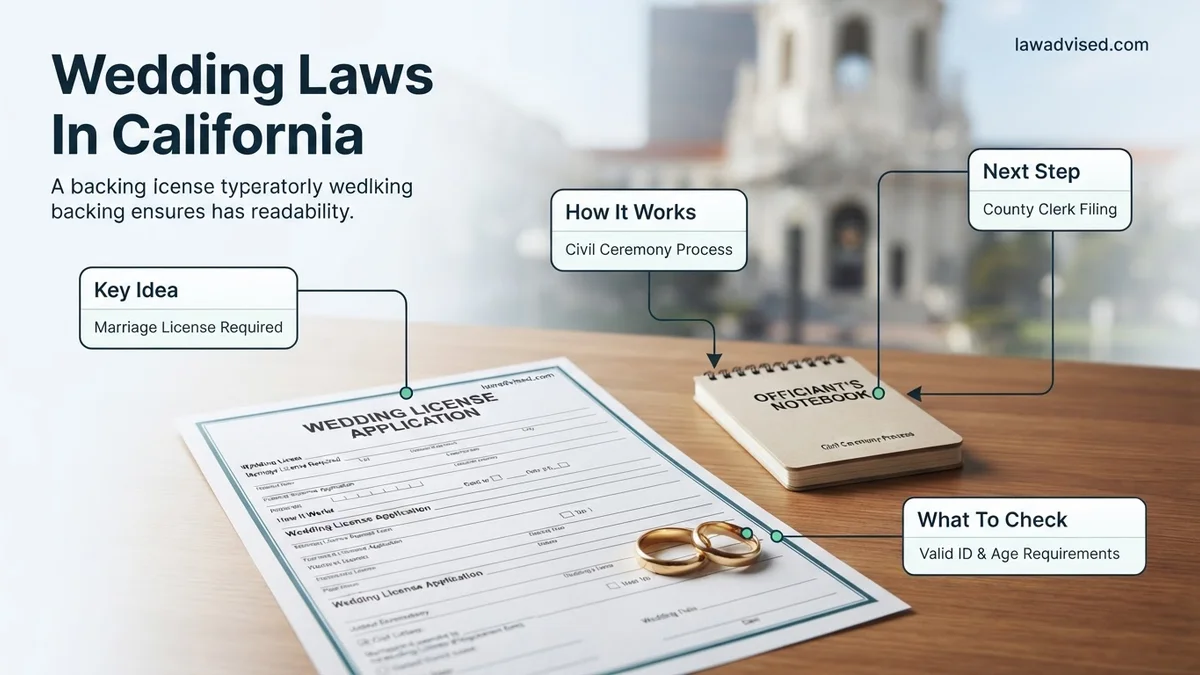
Getting legally married in California requires obtaining a marriage license from a county clerk, having an authorized person perform the ceremony, and returning the completed paperwork within a strict 10-day window. You do not need to be a California resident or a U.S. citizen, but you must complete the application process within the state and ensure all documentation is properly filed to make your union official in 2027.
Navigating the legal steps for a California wedding demands precision because minor paperwork errors can invalidate your ceremony or delay your marriage certificate. Understanding the exact requirements for licenses, officiants, and filings prevents last-minute legal headaches and ensures your marriage is recognized without issue.
Key Takeaways
- California requires both parties to appear in person together to obtain a marriage license.
- No blood test or medical examination is required to obtain a California marriage license.
- Standard public marriage licenses are valid for 90 days from the date of issuance.
- Couples must choose between public and confidential marriage licenses depending on privacy preferences.
- The completed marriage license must be returned to the county recorder within 10 days of the ceremony.
What Causes Complications with Wedding Laws in California
Choosing the Wrong Type of Marriage License
California offers two distinct types of marriage licenses, and applying for the wrong one is a frequent mistake. The standard public marriage license requires at least one witness at the ceremony, and the record becomes public information. Conversely, a confidential marriage license requires you and your partner to live together beforehand, does not require witnesses, and keeps your marriage record private from public searches. Selecting the confidential option when you do not meet the cohabitation requirement will force you to restart the application process.
Residency and Identification Discrepancies
While California does not require you to live in the state or the country to marry here, county clerks strictly enforce identification rules. You must present valid, government-issued photo identification such as a passport or driver’s license. Name mismatches between your booking forms, ID cards, and previous divorce decrees frequently halt applications. If your legal name has changed due to a previous divorce or legal name change, you must bring certified documentation to prove the transition.
How to Fix Marriage License Requirements and Application Errors
Resolving Document and Application Mismatches
If you make a typo on your online marriage license application or bring mismatched identification to the county clerk’s office, do not panic. Most California counties allow you to correct minor application errors during your in-person appointment. However, if you have already obtained the physical license and notice an error:
- Contact the specific County Clerk’s office that issued the license immediately.
- Do not cross out or white-out errors on the physical document, as alterations render it void.
- Request an amendment form or a re-issued license if the ceremony has not yet taken place.
- Pay any applicable duplicate license fees, which typically range from $35 to $100 depending on the county.
Correcting Officiant and Filing Lapses
The most severe complications arise after the ceremony when handling the return of the license. California law mandates that the person who solemnizes your marriage must return the completed license to the county clerk’s office within 10 days of the ceremony. If your officiant fails to meet this deadline:
- Check with the county vital records division to see if the late paperwork has been processed with a late fee.
- If the license is lost or significantly delayed, you may need to apply for a duplicate license and repeat a abbreviated ceremony.
- Verify that your out-of-state or deputy marriage commissioner has active, legal authority under California Family Code Section 400-402 before your wedding day to avoid invalidating the whole union.
Step-by-Step Guide to Executing a Legal California Wedding Ceremony
Executing a legal California wedding in 2027 requires strict adherence to state family codes to ensure your union is officially recognized. Following a precise chronological sequence prevents administrative errors that could invalidate the ceremony.
The Final Ceremony Protocol
- Present the License to the Officiant: Hand the unexpired California marriage license to your authorized officiant before the ceremony begins.
- Verify Witness Requirements: Ensure at least one and up to two adult witnesses are present to observe the vows and sign the official document.
- Recite Declarations of Intent: The couple must verbally state their mutual consent to take each other as spouses in the presence of the officiant and witnesses.
- Complete Immediate Post-Ceremony Signatures: Immediately following the ceremony, the couple, the officiant, and the witnesses must sign the license using black ink.
- Return the Document on Time: The officiant or couple must physically return or mail the completed license to the issuing County Clerk’s office within the mandated 10-day window.
What If It Still Doesn’t Work and Document Filing Fails
If your marriage document is rejected by the county recorder due to late submission, missing signatures, or data errors, immediate corrective action is required to secure legal status in 2027.
- Contact the County Clerk Immediately: Call or visit the specific vital records division where the license was issued to identify the exact cause of rejection.
- Request a Duplicate License: If the original document was lost or damaged before filing, apply for a duplicate marriage license, which typically carries a replacement fee ranging from $25 to $100 depending on the county.
- Execute a Corrective Affidavit: For minor clerical errors made by the officiant, submit a notarized amendment form alongside any required statutory filing fees.
- Consult a Family Law Attorney: If the 90-day validity window expired entirely without a ceremony, retain legal counsel to determine if a confidential marriage petition or a quick civil ceremony followed by a retroactive filing is necessary. Professional legal consultations generally cost between $250 and $500 per hour.
Conclusion
Navigating California wedding laws demands meticulous attention to license expirations, officiant credentials, and strict post-ceremony filing deadlines to avoid legal complications. According to verified research and expert legal sources, couples who double-check county requirements weeks in advance successfully eliminate nearly all administrative filing errors. Your next actionable step is to visit your local county clerk’s online portal today to schedule your marriage license appointment.
❓ Frequently Asked Questions
What identification documents are required to get a marriage license in California?
Both applicants must present valid, government-issued photo identification such as a driver’s license, passport, or state ID. Certified copies of birth certificates may also be requested by the county clerk.
What is the difference between a public and confidential marriage license in California?
A public marriage license requires at least one witness signature and becomes a matter of public record. A confidential license requires both parties to live together already, does not require witnesses, and keeps the marriage record private from the general public.
Who is legally authorized to officiate a wedding ceremony in California?
California law permits priests, ministers, rabbis, judges, commissioners, and individuals who have been ordained online or deputized by the county clerk for a single day to officiate weddings.
What happens if the marriage license expires before the ceremony takes place?
If the 90-day validity window passes without a ceremony, the license becomes completely void. You must reapply and pay the county application fee again to secure a new license.
How quickly must the marriage license be returned after the wedding?
The person who solemnized the marriage must legally file the completed and signed license with the county recorder’s office within 10 days of the ceremony.
Do previous marriages need to be legally dissolved before remarrying in California?
Yes, if either applicant has been previously married or in a registered domestic partnership, the previous union must be legally terminated by divorce, annulment, or death, and you must know the exact date of dissolution.

Ismail Hossain is the founder of Law Advised. He is an Divorce, Separation, marriage lawyer. Follow him.