Hunting Laws in California 2027 Expert Step-by-Step Guide
Navigating hunting laws in California requires strict adherence to California Department of Fish and Wildlife (CDFW) regulations, including mandatory hunter education, proper licensing, and statewide non-lead ammunition bans. Hunters must carefully verify current season dates, weapon restrictions, and specific bag limits for each game zone to remain legally compliant.
California hunting laws for the 2027 season require strict adherence to California Department of Fish and Wildlife (CDFW) codes, specific weapon restrictions, and precise tag reporting timelines. Navigating the Golden State’s regulatory landscape demands careful planning because wardens enforce bag limits, zone boundaries, and non-lead ammunition mandates rigorously.
Understanding these legal frameworks protects your hunting privileges and ensures ethical harvests across public and private lands. Whether you are pursuing Roosevelt elk in the north or wild pigs in the central foothills, compliance with current 2027 statutes is your primary responsibility in the field.
Key Takeaways
- Pass a certified hunter education course before purchasing a California hunting license.
- Use statewide mandatory non-lead ammunition for all hunting with firearms.
- Check specific zone maps and season dates annually through CDFW regulations.
- Report all harvest tags immediately as required by state law.
- Wear the mandatory minimum requirement of hunter orange during specific big game seasons.
What Causes Violations of Hunting Laws in California
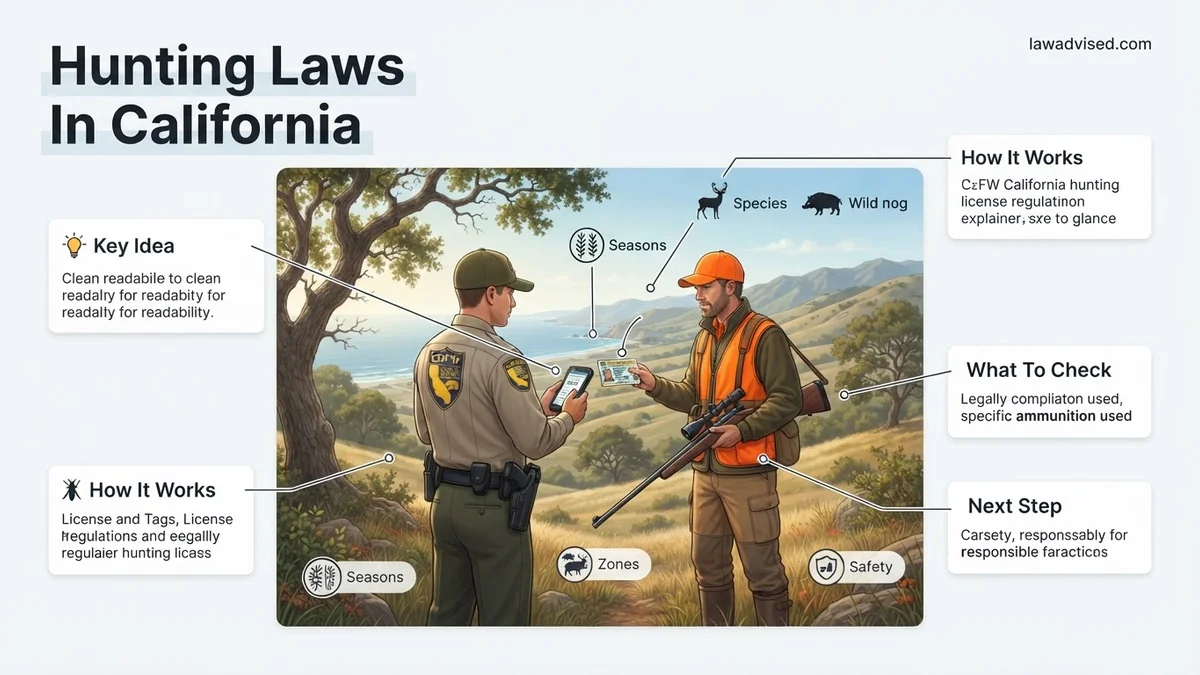
Most game violations in California stem from honest mistakes regarding boundary lines, failure to immediately notch tags, or using prohibited gear. Warden citations carry heavy fines, potential jail time, and permanent revocation of your hunting privileges across multiple states through the Interstate Wildlife Violator Compact.
Common Tag and Transport Infractions
You must validate your tag immediately upon harvesting a big game animal by cutting out the month and day of the kill. Failing to notch the tag on site is one of the most frequent citations issued by CDFW wildlife officers. Additionally, transporting meat or antlers without keeping the required evidence of sex attached to the carcass violates state statute.
Non-Lead Ammunition and Firearm Restrictions
California enforces a total ban on lead ammunition for taking any wildlife with a firearm. Using traditional lead bullets for upland birds, small game, or big game guarantees a hefty fine. You must also carry proof that your ammunition is certified non-lead by the CDFW whenever you possess a firearm in hunting areas during the 2027 season.
How to Fix License, Tag, and Validation Requirements
Securing legal authorization to hunt in California requires a valid annual hunting license, specific species tags, and required federal or state validations. The state utilizes the Automated License Data System (ALDS) to process all purchases online or through licensed agent locations.
Step-by-Step License and Hunter Education Acquisition
Before purchasing any 2027 hunting credentials, you must fulfill the state’s mandatory hunter education prerequisite. Follow this sequence to ensure complete legal compliance:
- Complete Hunter Education: Pass a certified 10-hour classroom course or approved online equivalent, earning your California hunter education certificate.
- Purchase Your Annual License: Buy your 2027 California resident or nonresident hunting license online via the CDFW ALDS portal or at an authorized sporting goods retailer.
- Add Required Validations: Purchase the specific state validations for waterfowl, upland game birds, or wild pigs depending on your targeted species.
- Apply for Big Game Drawings: Submit your big game draw applications for deer, elk, pronghorn, and bighorn sheep before the designated spring deadlines.
- Over-the-Counter Tags: Purchase general deer tags, bear tags, and second pig tags directly through the ALDS system starting in July 2027.
Reporting Requirements and Deadlines
Purchasing your tags is only half the battle; reporting your harvest or non-success is a strict legal requirement in 2027. You must report the harvest status of every big game tag you own, even if you did not harvest an animal or never went afield. Failing to report by the January 31 deadline results in steep non-completion penalties applied to your account for the following season.
Step-by-Step Guide to Complying with Ammunition and Weapon Restrictions
California enforces some of the strictest weapon and ammunition mandates in the nation. Navigating these rules successfully requires strict adherence to state wildlife and firearms codes for the 2027 season.
Sub-step 1: Verify Non-Lead Ammunition Compliance
Statewide non-lead ammunition is mandatory for all hunting with firearms, including all big game, upland game birds, and nongame species. According to the California Department of Fish and Wildlife (CDFW), possessing lead ammunition while taking wildlife with a firearm carries steep penalties.
- Check the CDFW certified non-lead ammunition list before purchasing bullets or shot shells.
- Ensure all historical stockpiles of lead-core ammunition are removed from your hunting kit prior to entering the field.
- Retain purchase receipts for non-lead ammunition as proof of compliance during random warden checks.
Sub-step 2: Confirm Firearm Magazine and Configuration Limits
Semi-automatic rifles used for big game must comply with strict magazine capacity restrictions. Centerfire rifles are generally limited to fixed magazines holding no more than five rounds under current 2027 regulations. Bowhunters must similarly verify that draw weights and broadhead specifications meet minimum legal thresholds to ensure ethical and lawful harvests.
What If Seasons, Bag Limits, or Regulations Change Unexpectedly?
Emergency closures and sudden quota adjustments occur frequently due to environmental shifts, wildfire impacts, or wildlife disease outbreaks. Hunters must remain vigilant throughout the 2027 season to avoid inadvertent violations.
Sub-step 1: Check Weekly Emergency Notices
Always review the CDFW website or mobile portal for emergency updates immediately prior to heading into the field. Regulations published in the annual printed digest can be superseded by mid-season emergency declarations.
Sub-step 2: Utilize the Official CDFW Wildlife Officer Hotline
When encountering ambiguous boundary lines or sudden regulatory shifts, contact local wildlife dispatch directly. Documenting your inquiry provides a verifiable record of due diligence.
What If It Still Doesn’t Work?
If you encounter complex regulatory conflicts, permit lottery rejections, or licensing discrepancies that standard online portals cannot resolve, take these immediate fallback steps:
- Visit a regional CDFW license sales office in person to manually audit your Automated License Data System (ALDS) profile. This bypasses online processing delays.
- Consult a specialized wildlife and environmental attorney licensed in California if facing contested citations or complex private land access disputes. Professional legal consultation typically ranges from $250 to $500 per hour depending on complexity.
- Contact the erratic tag support desk via phone during standard business hours to resolve point allocation errors before drawing deadlines close.
- Join a recognized sportsmen’s advocacy organization, such as the California Rifle & Pistol Association (CRPA), for real-time legal updates and member support regarding sudden legislative updates.
Conclusion
Navigating California hunting laws demands constant vigilance, strict non-lead ammunition compliance, and regular verification of seasonal updates. According to verified research and expert sources from wildlife management authorities, proactive preparation remains the single most effective tool for a legal and successful hunt. Your immediate next step is to log into your CDFW account today to verify your 2027 license status and review the latest zone-specific restriction summaries.
❓ Frequently Asked Questions
What documents do I need to carry while hunting in California?
You must carry your physical hunting license with all necessary validations, required tags for the species you are hunting, and a government-issued photo ID at all times while in the field.
How are bag limits and possession limits enforced?
Bag limits restrict the number of animals you can take in a single day, while possession limits dictate the maximum number you can legally hold. Exceeding these limits carries severe fines and potential confiscation of equipment.
What are the rules regarding hunting on private property in California?
Hunting on private property always requires explicit written or verbal permission from the landowner or tenant. Trespassing while hunting is a serious misdemeanor that can result in the permanent revocation of your hunting privileges.
Can I use electronic calls for hunting game species?
Regulations on electronic calls vary significantly by species. They are generally prohibited for big game like deer and bear but may be legal for certain nongame or predator species under specific conditions.
What should I do if I wound an animal and it crosses onto private property?
You cannot enter private property to retrieve game without the landowner’s permission. Contact the landowner or local law enforcement/game wardens immediately to request assistance with lawful retrieval.
How do non-lead ammunition requirements apply to rimfire firearms?
The non-lead ammunition mandate applies universally to all wildlife taken with any firearm, which includes rimfire calibers used for small game and varmint hunting across all public and private lands.

Ismail Hossain is the founder of Law Advised. He is an Divorce, Separation, marriage lawyer. Follow him.