New Car Seat Laws in California 2027 Expert Compliance Guide
California law mandates that children must ride rear-facing until at least 2 years of age, unless they reach 40 pounds or 40 inches tall. Understanding these strict child passenger safety requirements prevents costly tickets and keeps young passengers fully protected.
California child passenger safety regulations require children under the age of 2 to ride in a rear-facing car seat unless they reach 40 pounds or 40 inches tall. If you drive in the state through 2027, you must follow these strict mandates to protect your child and avoid hefty traffic fines and penalty points on your driving record.
Staying compliant means tracking your child’s age, weight, and height precisely against evolving state vehicle codes. This expert compliance guide breaks down the core rules for rear-facing seats, forward-facing harnesses, and booster transitions so you can drive with complete peace of mind.
Key Takeaways
- Children must remain in a rear-facing car seat until age 2, 40 pounds, or 40 inches.
- Children under 8 years old must be secured in a car seat or booster in the back seat.
- Children reach booster seat graduation when they are 8 years old or 4 feet 9 inches tall.
- First-time violations require paying fines and attending a child passenger safety education program.
- All car seats used must meet federal motor vehicle safety standards and match the child’s size.
What Causes Child Passenger Safety Violations Under California Law
Premature Transition to Forward-Facing Seats
The most common violation parents make is turning a child forward-facing too early. California law explicitly mandates that children remain in a rear-facing car seat until they are at least 2 years old. Many parents mistakenly transition their toddlers based solely on age, forgetting the critical height and weight qualifiers. If your child turns 2 but weighs less than 40 pounds or measures under 40 inches, moving them to a forward-facing seat violates state law.
Improper Booster Seat and Seat Belt Usage
Another frequent citation involves moving children out of booster seats prematurely. Under current California guidelines, children under the age of 8 must be secured in a car seat or booster seat in the back seat. Parents often let children graduate to regular seat belts too soon. A violation occurs if a child under 8 uses a standard adult seat belt without a booster, or if children sit in the front seat when rear seating is available.
- Transitioning a child under 2 years old to a forward-facing harness prematurely.
- Ignoring the dual 40-pound and 40-inch rear-facing limits.
- Allowing children under 8 years old to ride without a booster seat in the back seat.
- Placing a child in the front seat when the vehicle has an active passenger airbag and rear seats.
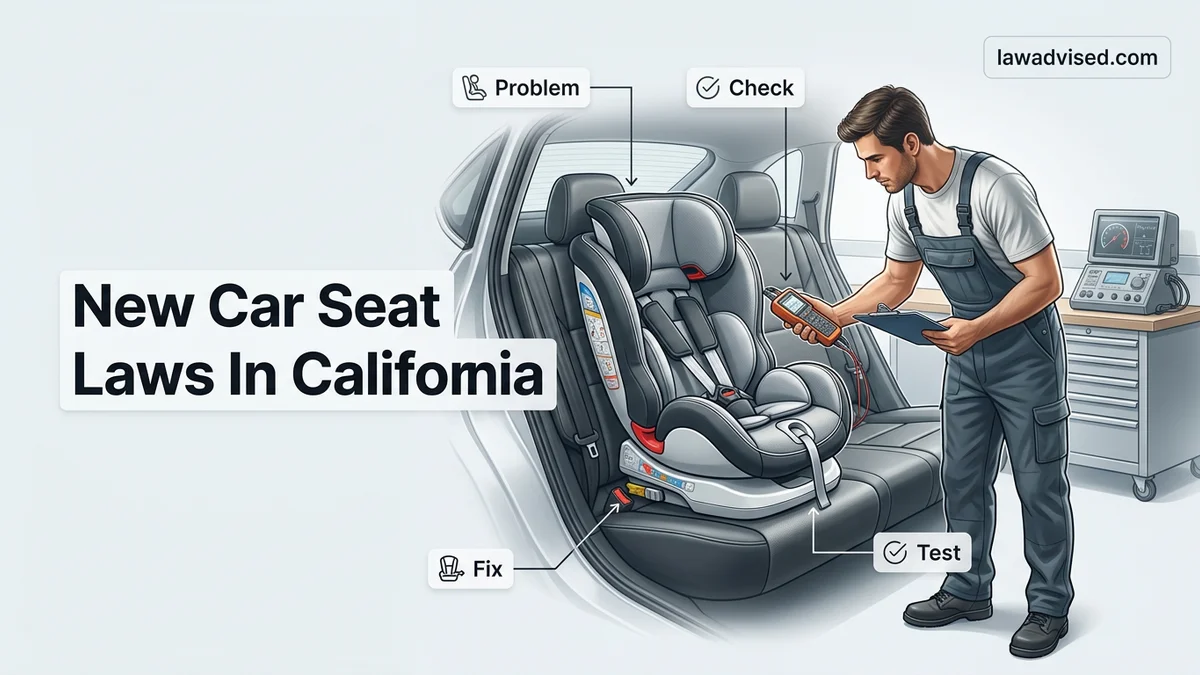
How to Fix Car Seat Compliance and Follow California Rules Step-by-Step
Step 1: Measure Your Child and Evaluate Current Seats
Start by auditing your child’s exact height and weight against your current car seat manufacturer limits. If your child is under 2, check that their rear-facing seat accommodates up to 40 pounds or 40 inches. If they max out these limits before age 2, you must purchase a high-capacity rear-facing convertible seat rather than turning them forward.
Step 2: Enforce the Age 8 Booster Mandate Correctly
Keep children in a high-back or backless booster seat until they meet both the age and height milestones set by the state. California permits children to use standard adult lap and shoulder seat belts only when they reach 8 years old OR hit a height of 4 feet 9 inches. Test the fit using the vehicle’s built-in belt: the lap belt must lie low across the hips, and the shoulder belt must cross the center of the chest.
- Weigh and measure your child monthly to track compliance thresholds.
- Keep toddlers rear-facing past age 2 if they have not hit the 40-pound or 40-inch mark.
- Utilize a belt-positioning booster seat until your child reaches 4 feet 9 inches tall or turns 8.
- Verify that the vehicle seat belt fits snugly across the upper thighs and chest without resting on the neck or face.
What If Your Child Outgrows Standard Seats Before Age Requirements
Every child develops at a unique rate, and some children exceed standard height and weight parameters before reaching the mandatory age thresholds outlined in California law. When a tall or heavy child outgrows standard forward-facing internal harnesses prematurely, parents often face a difficult dilemma. According to the National Highway Traffic Safety Administration (NHTSA), removing a child from a harnessed restraint too early drastically reduces crash protection.
Handling Size Discrepancies Safely
To remain compliant with 2027 California standards while keeping children secure, parents must look for specialized high-capacity car seats. Standard forward-facing seats typically max out at 65 pounds, but specialized combination seats offer internal five-point harnesses rated up to 90 pounds. Utilizing these heavy-duty harnessed seats allows compliance with the age-two and age-eight rules without sacrificing harness security for larger children.
Transitioning to High-Back Boosters
If a child surpasses the maximum harness limits before turning eight, transitioning to a belt-positioning booster seat is legally permitted under California vehicle code, provided the child meets the height and weight specifications of the booster manufacturer. Experts recommend high-back booster seats for children who outgrow their harnesses early, as they provide critical head and neck support and ensure proper vehicle seatbelt routing across the chest and lap.
Proven Strategies to Avoid Fines and Meet State Safety Standards
Enforcement of California child passenger safety laws is strict, and non-compliance carries steep financial penalties and point assessments on driving records. A first-time violation typically results in fines exceeding $500 once court fees and state penalties are applied, alongside a mandatory court appearance. Implementing proactive compliance strategies protects both child passengers and family finances.
Utilizing Professional Inspection Stations
Incorrect installation remains a primary reason parents face citations or fail to protect their children adequately in collisions. The California Highway Patrol (CHP) operates numerous child safety seat inspection stations throughout the state. Certified Child Passenger Safety (CPS) technicians inspect installations free of charge or for a nominal community fee, ensuring compliance with both state statutes and manufacturer guidelines.
Maintaining Compliance Documentation
- Register every car seat directly with the manufacturer immediately after purchase to receive vital safety recall notices.
- Keep a digital copy of the car seat manual and vehicle compatibility chart in the glove compartment for roadside verification if needed.
- Check the embossed expiration date on the car seat shell annually, as degraded plastic compromises structural integrity and violates state safety standards.
What If It Still Doesn’t Work?
If standard installation methods fail due to complex vehicle seat contours, stubborn seatbelts, or incompatible Lower Anchors and Tethers for Children (LATCH) systems, parents should take immediate corrective action rather than risking non-compliance. Follow these troubleshooting steps to resolve persistent setup failures:
- Switch from the LATCH system to the vehicle seatbelt installation method, or vice versa, as vehicle manual restrictions often dictate which method is permitted in specific seating positions.
- Consult a certified Child Passenger Safety (CPS) technician for an in-person evaluation. Local fire departments and CHP offices offer these services, with professional private consultations generally ranging from $40 to $80.
- Contact the car seat manufacturer directly for custom vehicle-specific locking clips or tether extension hardware.
- Replace the car seat entirely if it is past its expiration date, was subjected to a moderate or severe crash, or shows signs of micro-fractures in the plastic shell. Replacement costs typically range from $150 to $350 depending on the model tier.
Conclusion
Navigating the strict 2027 California car seat regulations requires vigilance regarding height, weight, and age milestones to guarantee absolute legal compliance and optimal child safety. According to verified research and expert sources from the National Highway Traffic Safety Administration and the California Highway Patrol, utilizing high-capacity harnessed seats and verifying installations with certified technicians eliminates costly fines and prevents catastrophic injuries. Take your next actionable step today by scheduling a professional car seat inspection at your local California Highway Patrol office to ensure your child travels with maximum protection.
❓ Frequently Asked Questions
What are the exact rear-facing requirements under California law?
California law requires all children to ride in a rear-facing car seat until they turn 2 years old, weigh 40 pounds, or reach 40 inches in height. Whichever milestone is reached first dictates when the child can transition to a forward-facing seat.
Can a child sit in the front seat if the back seat is full?
Children may sit in the front seat only if all rear seats are occupied by younger children aged 7 or under, or if the vehicle lacks rear seats. However, the active frontal airbag must be turned off if a rear-facing seat is placed in the front.
What constitutes a legal booster seat in California?
A legal booster seat must elevate the child so that the vehicle lap and shoulder safety belts fit correctly across the upper thighs and chest. It must also comply with federal safety standards and match the manufacturer weight limits.
What happens if you get pulled over with an improperly restrained child?
Law enforcement can issue a ticket for each improperly secured child in the vehicle. First-time offenders usually face monetary fines and are required to attend a certified child passenger safety training class.
How do you know when a car seat is expired?
Car seat expiration dates are stamped directly into the plastic shell or listed on the manufacturer label, typically expiring six years from the date of manufacture due to material degradation over time.
Are rideshare vehicles like Uber and Lyft exempt from California car seat laws?
Rideshare vehicles are not legally exempt from child passenger safety laws in California. Parents must provide their own car seats or use a rideshare service equipped with pre-installed child safety seats.

Ismail Hossain is the founder of Law Advised. He is an Divorce, Separation, marriage lawyer. Follow him.