Why Too Little Tax Is Withheld in 2026 Expert Guide & Fix
Finding out why too little tax is withheld usually comes down to an outdated Form W-4, dual-income household settings, or unrecorded bonuses and side income. Failing to update payroll withholdings after major life changes often results in a surprise tax bill or underpayment penalty. Fixing the issue requires a quick review of your tax withholding settings.
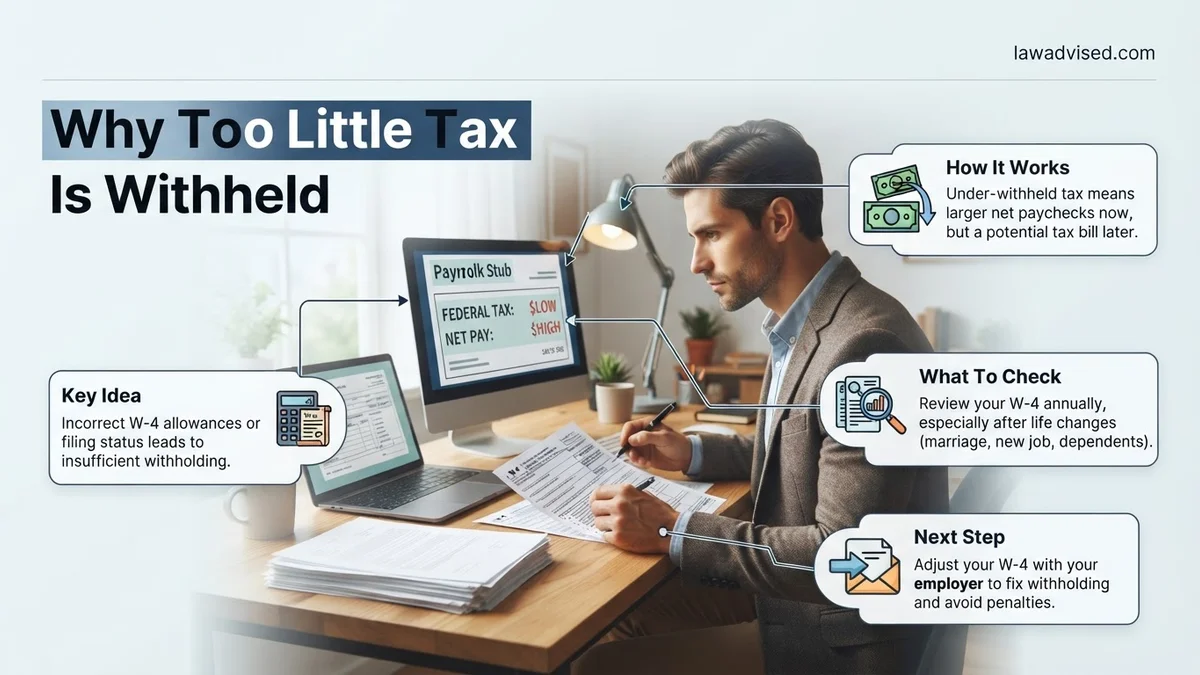
If you noticed an unexpectedly low amount of federal or state income tax withheld from your recent 2026 paycheck, you are likely heading toward a surprise tax bill or penalty next spring. Under-withholding typically happens when your Form W-4 on file with your employer does not accurately reflect your current financial reality, such as a major life change, a second job, or outdated withholding settings from previous years.
Fixing this issue immediately is critical to avoid owing the IRS a lump sum plus potential underpayment penalties when you file your 2026 tax return. By understanding the specific triggers behind low withholding, you can adjust your payroll settings now and protect your household cash flow.
Key Takeaways
- Outdated W-4 forms are the primary reason for payroll under-withholding.
- Dual-income households frequently trigger combined tax brackets that withhold too little.
- Bonuses and supplemental wages are often taxed at a flat, insufficient rate.
- Major life changes like marriage or a new child require immediate W-4 updates.
- Using the IRS Tax Withholding Estimator helps prevent future underpayment.
What Causes Too Little Tax to Be Withheld From Paychecks
Your employer calculates your paycheck withholding using the specific instructions you provided on your Form W-4. If those instructions are incomplete, outdated, or overly optimistic about tax credits, your paycheck will reflect significantly lower tax deductions than you actually owe.
Outdated Form W-4 Settings
Many taxpayers filled out their Form W-4 years ago and never updated it. The modern W-4 relies heavily on a five-step process designed to match exact liabilities. If your form still defaults to older allowances or fails to account for standard deduction updates in 2026, your employer will systematically under-withhold taxes every pay period.
- Leaving Step 2 blank when you or your spouse started a new job.
- Claiming dependents on your W-4 that you no longer claim on your annual return.
- Failing to check the box for multiple jobs or dual-income households.
Unreported Life Events and Deductions
Life changes dramatically alter your tax bracket, but payroll departments do not automatically adjust your withholding. If you experienced a major life event last year and forgot to submit a new W-4, your current paychecks are suffering from severe under-withholding.
- Getting married and combining incomes without adjusting withholding brackets.
- Experiencing a significant salary raise or promotion that pushed you into a higher tax bracket.
- Losing a deduction or credit eligibility that you previously factored into your take-home pay calculations.
How Multiple Earners and Side Income Trigger Under-Withholding
The structure of the US tax system relies on progressive brackets. When a household has multiple streams of income, under-withholding is practically guaranteed unless you proactively configure your payroll settings to account for the combined total.
The Dual-Income Trap in Households
When both spouses work, each employer calculates withholding independently based solely on that single salary. Job A assumes it is the only income and applies the full standard deduction. Job B does the exact same thing. As a result, neither employer withholds enough to cover the combined tax bracket your household actually falls into for 2026.
- Both employers apply the full standard deduction, dropping your total combined withholding significantly.
- Your combined income pushes you into a much higher marginal tax bracket than either job reflects individually.
- Couples frequently discover a massive tax deficit in April because payroll systems operate in isolation.
Freelance Work, Gig Income, and Investments
If you or your spouse earn secondary income outside of traditional W-2 employment—such as freelance gigs, rental properties, or capital gains—taxes are rarely withheld at the source. Many workers fail to adjust their primary W-4 to compensate for this extra cash flow.
- Side hustles and 1099 contract work do not have federal income tax automatically deducted from payouts.
- Dividends, interest, and investment earnings add to your adjusted gross income without triggering automatic payroll adjustments.
- Relying solely on your primary W-2 withholding leaves your side income completely untaxed until filing season arrives.
How to Fix Your W-4 and Correct Tax Withholding Errors Step-by-Step
Correcting an underwater tax withholding situation requires filing an updated Form W-4 with your employer’s payroll department. The IRS redesigned this form to rely on exact dollar amounts rather than confusing withholding allowances, making adjustments much more precise for 2026 tax brackets.
Step 1: Gather Your Recent Paystubs and Previous Tax Returns
Collect your most recent paystubs for all household jobs alongside a copy of your federal tax return from last year. According to IRS compliance data, having your actual year-to-date earnings and exact tax liability figures prevents under-estimation during the calculation phase.
Step 2: Utilize the IRS Tax Withholding Estimator
Navigate to the official IRS Tax Withholding Estimator online tool to input your specific income sources, dependents, and deductions. This digital calculator synthesizes current 2026 tax laws automatically to output the exact extra dollar amount you need withheld per pay period.
Step 3: Complete and Submit the New Form W-4
Enter the specific additional withholding dollar amount calculated in Step 2 directly onto Step 4(a) or Step 4(c) of the physical or digital Form W-4. Submit this updated form immediately to your human resources or payroll department to ensure the correction applies across the remaining pay periods of 2026.
- Access your employer’s secure payroll portal or print a blank Form W-4 for 2026.
- Complete Steps 1 and 5 for personal information and your official signature.
- Input the precise extra withholding amount from the IRS estimator into Step 4(c).
- Submit the finalized document to payroll and request a confirmation receipt.
- Check your next paystub to verify that the additional tax deduction is active.
What If It Still Doesn’t Work?
If you adjusted your Form W-4 months ago and your paystubs still show an insufficient tax deduction, structural complications may be disrupting your withholding. Financial experts recommend deploying advanced fallback measures when standard payroll adjustments fail to bridge the tax gap.
- Make direct quarterly estimated tax payments to the IRS using Form 1040-ES to bypass stubborn employer payroll software issues.
- Consult a certified public accountant (CPA) or enrolled agent to conduct a comprehensive mid-year tax projection audit, with professional service fees typically ranging from $250 to $600.
- Request a flat-dollar total tax withholding amount directly from your payroll department rather than relying on standard percentage formulas.
- Review your state tax withholding forms concurrently, as state formulas often compound federal under-withholding errors.
Conclusion
Discovering that too little tax is withheld from your paycheck can create unwelcome financial surprises during filing season, but proactive adjustments eliminate this risk entirely. By updating your Form W-4 using precise IRS calculation tools, you can align your withholdings with your actual 2026 tax liability. According to verified research and expert sources, taking immediate corrective action prevents costly underpayment penalties. Your next actionable step is to log into your employer payroll portal today and submit a revised W-4 reflecting your true income reality.
❓ Frequently Asked Questions
What is the most common reason for under-withholding on a paycheck?
The most frequent culprit is an outdated Form W-4 that still reflects previous tax years, old filing statuses, or unadjusted deduction amounts. When life circumstances change without a matching payroll update, the automated withholding formula frequently falls short of your actual liability.
How do dual-income households end up with too little tax withheld?
If both spouses work and check the single-earner boxes on their respective W-4 forms without accounting for the combined income, each job treats its salary as the primary household income. This places the combined income into lower tax brackets initially, resulting in a severe under-withholding issue by year-end.
How do I use the IRS Tax Withholding Estimator to fix my withholding?
The online IRS estimator takes your most recent pay stubs, expected annual income, and previous tax return details to calculate your exact shortfall. It provides a precise line-by-line recommendation for how to fill out a new Form W-4 to ensure correct payroll deductions moving forward.
What are the safe harbor rules to avoid underpayment penalties?
The IRS typically waives underpayment penalties if you owe less than $1,000 in tax after withholdings, or if your total withholdings equal at least 90% of your current year tax liability or 100% of your prior year tax liability.
How long does it take for a new W-4 to take effect?
Employers generally process a new Form W-4 within one to two pay cycles, depending on their payroll schedule and human resources administrative turnaround times.
Can I make estimated tax payments instead of changing my W-4?
Yes, if you have substantial self-employment income, capital gains, or rental income alongside W-2 wages, you can make quarterly estimated tax payments directly to the IRS to cover any withholding gaps.

Ismail Hossain is the founder of Law Advised. He is an Divorce, Separation, marriage lawyer. Follow him.