Underpayment Penalty Explained 2026 A Step-by-Step Guide
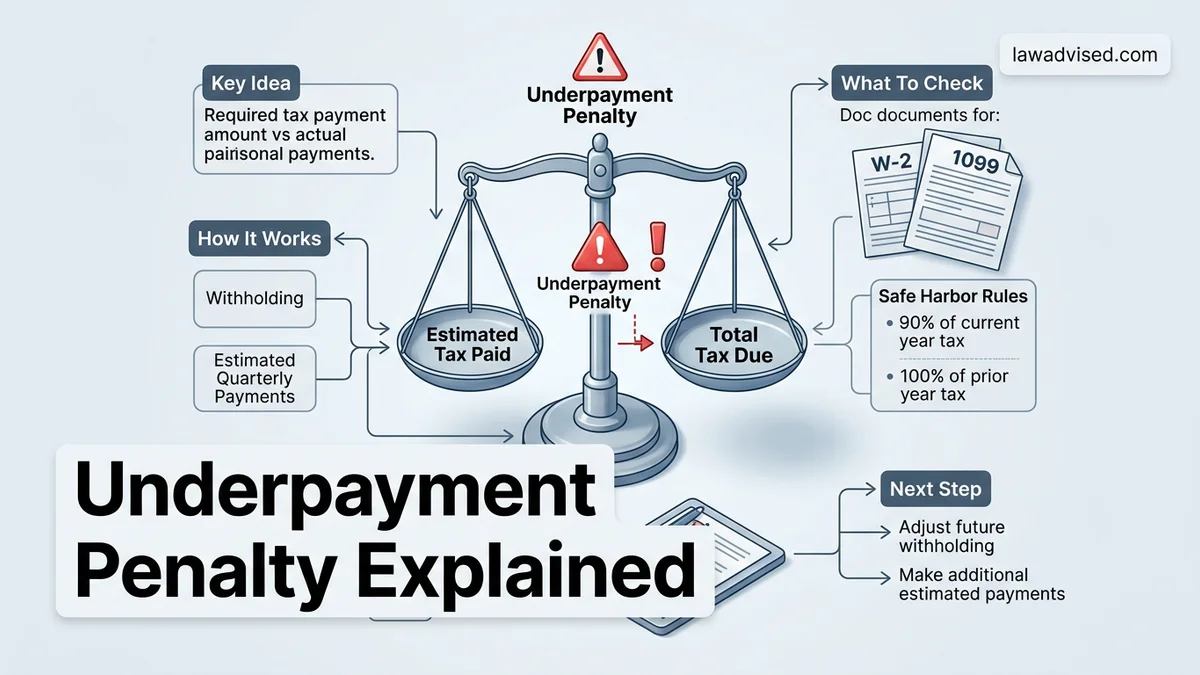
An underpayment penalty is charged by the IRS when you fail to pay enough tax throughout the year via withholding or estimated payments. You can easily avoid this fee by meeting safe harbor rules, such as paying at least 90% of your current tax liability or 100% of your prior year tax.
The IRS underpayment penalty is a fine charged to taxpayers who fail to pay enough tax throughout the year via withholding or estimated quarterly payments. If you end up owing a large sum at tax time in 2026, the government assumes you should have paid as you earned, triggering this extra fee on top of your standard tax bill.
This matters practically because the penalty is not just a flat fee; it includes compounding interest that increases the longer you wait to settle your account. Knowing how these rules work prevents surprise bills and helps you time your tax payments accurately to avoid unnecessary government charges.
Key Takeaways
- Pay at least 90% of your current year tax liability to avoid penalties.
- Use prior-year tax withholding as a safe harbor to bypass unexpected fees.
- The IRS calculates penalties based on the shortfall amount and the duration unpaid.
- File IRS Form 2210 to calculate your penalty or request a valid waiver.
- Qualifying life events like natural disasters or retirement can excuse you from penalties.
What Causes IRS Underpayment Penalties
The IRS operates on a pay-as-you-go tax system. You are expected to pay taxes throughout 2026 as you receive income, rather than waiting until the April filing deadline.
The Pay-As-You-Go Requirement
When you earn money through a W-2 job, your employer automatically withholds federal taxes. If you are a freelancer, contractor, or investor, you must make quarterly estimated tax payments. Falling short of the required thresholds during the year triggers the penalty, even if you pay your entire balance in full by April 2026.
Safe Harbor Rules to Avoid Penalties
You can completely avoid the underpayment penalty by meeting IRS safe harbor thresholds. You are safe from penalties if your total withholdings and estimated payments meet specific criteria:
- You pay at least 90 percent of the tax you owe for the 2026 tax year.
- You pay 100 percent of your total tax liability from the prior year (2025).
- If your adjusted gross income exceeded 150,000 dollars in 2025 (or 75,000 dollars if married filing separately), you must pay 110 percent of your 2025 tax liability to meet the safe harbor.
How to Calculate Your Penalty and Shortfall
The IRS calculates your penalty based on the size of your shortfall and the exact number of days that portion of tax remained unpaid.
Determining Your Shortfall
Your shortfall is the difference between what you actually paid through withholding or quarterly payments and the minimum amount required by the safe harbor rules. For example, if you owed 20,000 dollars total for 2026, and your safe harbor target was 18,000 dollars, but you only paid 14,000 dollars, your shortfall is 4,000 dollars.
Interest Rates and Duration
The IRS applies the federal short-term interest rate plus three percentage points to your shortfall. This rate can change quarterly. The penalty accrues daily from the date each quarterly payment was due until you pay it or until the April 2026 tax deadline passes. Because interest compounds daily, a relatively small tax shortfall can grow significantly over several months.
Step-by-Step Guide to Using Safe Harbor Rules
Navigating the IRS safe harbor provisions is the most reliable defense against a 2026 underpayment penalty. According to Treasury tax regulations, you can completely bypass penalties if your withholding and estimated payments meet specific statutory thresholds, regardless of your actual final tax bill.
Step 1: Calculate Your Prior Year Tax Liability
First, look at your 2025 federal income tax return. Locate the total tax figure, which is typically found on Line 24 of Form 1040. If your 2025 Adjusted Gross Income (AGI) exceeded $150,000 (or $75,000 if married filing separately), your safe harbor threshold increases to 110% of that prior year tax. Otherwise, the standard threshold remains at 100%.
Step 2: Determine the Current Year Percentage Threshold
Alternatively, you can target 90% of your expected 2026 tax liability. Tax experts recommend this method only if your current year income is dropping significantly compared to the previous year. You must calculate your projected 2026 adjusted gross income, deductions, and credits accurately to avoid falling short of this 90% mark.
Step 3: Execute Quarterly Payments
Divide your chosen safe harbor target amount into four equal installments. Submit these payments using IRS Form 1040-ES by the official quarterly deadlines for the 2026 tax year: April 15, June 15, September 15, and January 15, 2027. Meeting these exact dates prevents the daily compounding of interest and penalties on individual periods.
What If Your Waiver Request Fails
If the IRS rejects your initial request to waive the 2026 underpayment penalty due to casualty, disaster, or unusual circumstances, do not panic. Tax compliance specialists note that automated penalty assessments frequently face initial denials before manual review. You have several procedural recourse options available to contest the ruling further.
- File Formal Appeal Form: Submit IRS Form 843 (Claim for Refund and Request for Abatement) to formally request a reconsideration of the penalty charge based on reasonable cause.
- Attach Supporting Documentation: Include definitive proof of your hardship, such as medical records, disaster declarations, or employer bankruptcy filings, to substantiate your claim.
- Utilize First-Time Abate Policies: Ask the IRS if you qualify for a First-Time Penalty Abatement administrative waiver, provided you have a clean compliance record for the preceding three tax years.
- Engage Qualified Representation: Hire a certified public accountant (CPA) or enrolled agent if the disputed penalty amount exceeds $1,000. Professional representation fees typically range from $300 to $1,500 depending on case complexity.
Conclusion
An unexpected 2026 underpayment penalty can quickly disrupt your financial planning, but proactive safe harbor calculations and timely quarterly payments eliminate this risk entirely. According to verified research and expert sources from the American Institute of CPAs (AICPA), accurate forecasting remains your strongest defense against statutory interest charges. Your immediate actionable next step is to review your 2025 tax return today to establish your exact safe harbor baseline for the current tax year.
❓ Frequently Asked Questions
What triggers an IRS underpayment penalty?
The penalty is triggered when your total tax withholdings and quarterly estimated payments fall significantly short of what you actually owe when filing your annual return. Freelancers, contractors, and individuals with substantial investment income are most commonly affected.
How does the IRS calculate the underpayment interest rate?
The IRS sets penalty interest rates quarterly, typically based on the federal short-term rate plus three percentage points. Interest accrues daily on the unpaid tax amount from the date the payment was originally due until it is paid in full.
What is the 90% rule for estimated taxes?
The 90% rule is a safe harbor provision stating that you will not face an underpayment penalty if your total tax payments throughout the year equal at least 90% of the tax shown on your current year return.
How does the prior-year safe harbor protect me?
You can completely avoid underpayment penalties by paying 100% of the tax shown on your previous year’s tax return (increased to 110% if your adjusted gross income exceeds $150,000). This provides a predictable target regardless of how much you earn this year.
Do state tax agencies also charge underpayment penalties?
Yes, most state departments of revenue enforce their own rules and percentage penalties for state-level income tax underpayments. State safe harbor thresholds often mirror federal guidelines but require separate calculations.
What form do I need to file to report or calculate the penalty?
Taxpayers use IRS Form 2210 (Underpayment of Estimated Tax by Individuals, Estates, and Trusts) to calculate any penalty owed or to claim waivers and exceptions to reduce the owed amount.

Ismail Hossain is the founder of Law Advised. He is an Divorce, Separation, marriage lawyer. Follow him.