Recording Laws in California 2027 Expert Legal Guide
California is strictly a two-party consent state under Penal Code Section 632, meaning you cannot legally record confidential audio without everyone’s permission. Violating these laws carries severe criminal misdemeanors, heavy financial penalties, and the immediate inadmissibility of evidence in court. Understanding the exact line between public expectations of privacy and restricted conversations protects you from lawsuits.
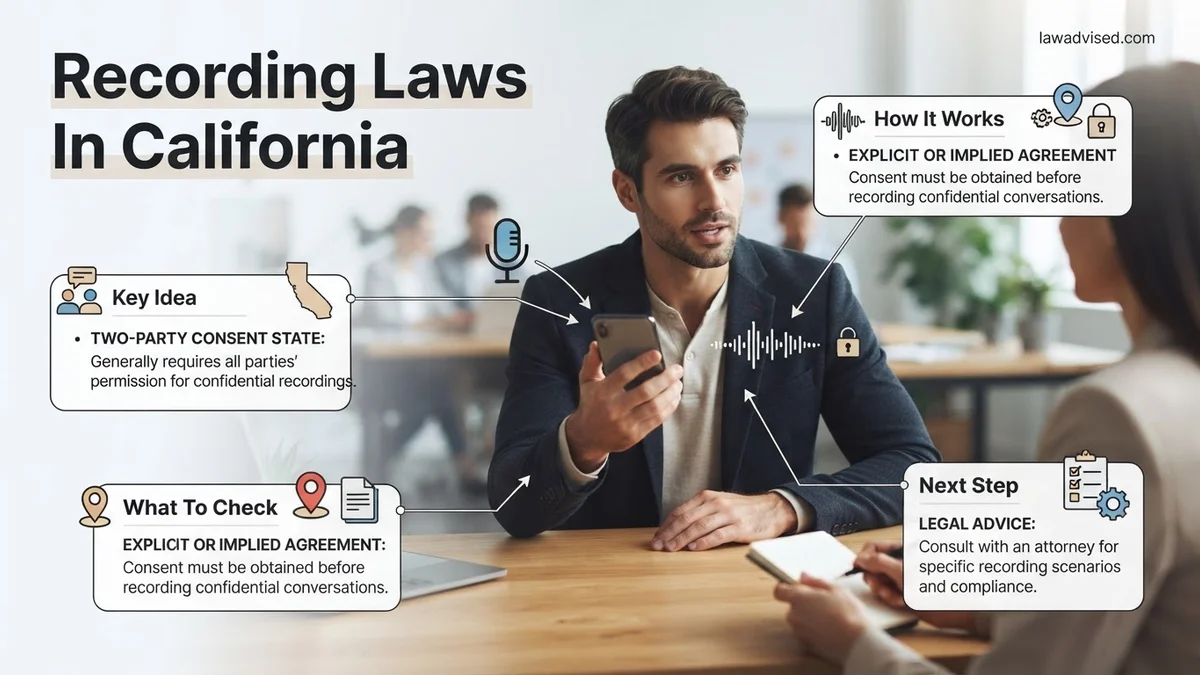
California is a strict two-party consent state under Penal Code Section 632. This means recording confidential communications without the explicit permission of every single participant is both a crime and a civil liability. If you capture private dialogue without consent in 2027, you face steep financial penalties, potential jail time, and the immediate disqualification of that audio as evidence in any court proceeding.
Navigating these restrictions is essential whether you are a journalist, a concerned citizen, or a business owner. Breaching these boundaries triggers severe legal consequences under California law. Understanding precisely where and when consent is legally required protects you from unexpected prosecution and civil lawsuits.
Key Takeaways
- California requires all parties to consent before you record confidential conversations.
- Audio recording without explicit permission violates Penal Code Section 632.
- Silent video recording in public places is generally legal where no privacy exists.
- Recording on-duty police officers in public spaces is fully protected by law.
- Illegal recordings carry heavy fines, potential jail time, and civil liability.
What Causes Legal Violations Under California Recording Laws
Penal Code Section 632 and Confidential Communications
The core trigger for a criminal violation in California is the recording of a confidential communication. The law defines this based on the objective circumstances. If the person speaking has an objectively reasonable expectation that no one is listening in or recording, the communication is confidential. You violate this statute the moment you hit record on your phone or hidden device without notifying everyone involved.
- Phone calls, private meetings, and intercom conversations are primary risk zones.
- Failing to give a verbal or written warning before recording triggers liability.
- Even if you are a participant in the conversation, you still need the other party’s consent if privacy is expected.
Criminal and Civil Penalties for Unauthorized Recording
Stepping over the line brings harsh statutory punishments. Under 2027 California guidelines, illegal wiretapping and audio recording carry severe penalties:
- Criminal Misdemeanor: Violating Penal Code 632 can result in up to one year in county jail, fines up to $2,500, or both for a first offense.
- Civil Damages: Victims can sue you directly for statutory damages of $5,000 per violation or three times the actual damages suffered, whichever is greater.
- Inadmissibility: Any recording obtained illegally is completely barred from being used as evidence in California courts.
How to Follow Two-Party Consent and Public Recording Rules Step-by-Step
Securing Legally Binding Consent Before Recording
To keep your recordings completely legal, you must establish clear, affirmative consent from every party before you start capturing audio. Relying on assumptions will expose you to liability.
- Make a verbal announcement at the very start of the conversation, such as stating, This call is being recorded for quality and training purposes.
- Check that the other party acknowledges the notice by speaking or continuing the dialogue after the warning.
- Obtain written consent via an email confirmation or signed release form for high-stakes business meetings or interviews.
- Stop recording immediately if someone objects or revokes their consent during the interaction.
Navigating Public Spaces and Exception Zones
The two-party consent rule applies specifically to confidential communications where privacy is expected. It does not apply everywhere. You generally do not need consent when recording in true public spaces.
- Public Streets and Parks: Filming and recording ambient audio on public sidewalks, protests, or parks where there is no reasonable expectation of privacy is legal.
- Law Enforcement on Duty: You have a First Amendment right to record police officers performing their duties in public spaces as long as you do not physically interfere with them.
- Loud Public Arguments: If people are shouting loudly in a public restaurant or open venue where anyone can overhear, they lack a reasonable expectation of privacy.
What If It Still Doesn’t Work: Handling Ambiguous Privacy Expectations
When recording in public spaces across California, determining whether a reasonable expectation of privacy exists can occasionally remain ambiguous. Even in 2027, modern surveillance technology and shifting judicial interpretations create gray areas that complicate everyday recording scenarios. Applying rigorous analytical frameworks helps mitigate legal risk before hitting record.
Assessing Environmental Context
Courts evaluate privacy expectations based on physical location and surrounding circumstances. A conversation held in a crowded public park inherently lacks privacy, whereas whispering in a private corporate breakroom generally maintains strict confidentiality protections under California law. Legal analysts recommend evaluating the acoustic and physical barriers present in the environment.
Evaluating Participant Behavior
Observe the behavior of the subjects prior to initiating any recording device. If individuals actively lower their voices, move away from crowds, or post clear signage prohibiting recording, a heightened expectation of privacy is legally established. Ignoring these behavioral cues drastically increases liability under the California Invasion of Privacy Act (CIPA).
Proven Best Practices for Legally Capturing Audio and Video
Navigating California’s complex recording statutes requires strict adherence to standardized protocols. Implementing proactive compliance measures ensures that recorded media remains legally admissible while protecting creators from civil and criminal penalties.
Step-by-Step Compliance Procedure
- Verify the jurisdiction: Always confirm whether the recording takes place in a traditional public forum or a private venue subject to strict multi-party consent mandates.
- Obtain explicit consent: Secure verbal or written consent from all participating parties before capturing private conversations, especially when utilizing hidden or wearable cameras.
- Display conspicuous notices: Post clear visual signage indicating that audio and video monitoring is actively in progress for commercial or residential properties.
- Consult legal counsel: Retain a qualified media attorney to review commercial recording projects, ensuring total alignment with current 2027 state statutes and precedents.
- Audit stored media: Regularly review and securely destroy unauthorized recordings that violate individual privacy rights or fail consent verification checks.
Conclusion
Navigating California recording laws demands constant vigilance, clear consent protocols, and an acute awareness of changing privacy expectations. Failure to properly assess legal boundaries can result in severe statutory damages and costly litigation. According to verified research and expert legal sources, proactive compliance remains the single most effective defense against CIPA violations. Take the next step by scheduling a formal legal consultation to review your organization’s current recording and surveillance policies today.
❓ Frequently Asked Questions
What legally constitutes a confidential communication in California?
A confidential communication refers to any conversation carried on under circumstances that reasonably indicate any party desires it to be confined to the parties, excluding public settings where eavesdropping is expected.
Does the two-party consent rule apply to video recordings?
The strict consent rule applies primarily to the audio portion of a recording. Silent video is governed by general privacy laws, which permit recording in public areas but prohibit it in private spaces like restrooms or dressing rooms.
Can I record a conversation if I am part of it?
Even if you are a participant in the conversation, you still need the consent of all other parties if the conversation is considered confidential under California Penal Code Section 632.
What exceptions exist for recording without consent?
Exceptions include recording public events, large gatherings, street protests, or conversations where the participants clearly lack any reasonable expectation of privacy, such as loud arguments in a public park.
Can employers secretly record employees in California?
Employers face strict limitations and generally cannot record employee conversations without consent unless there is no reasonable expectation of privacy in that specific workspace.
What civil damages can someone sue for under the invasion of privacy laws?
A person whose privacy was violated through illegal recording can sue for actual damages, statutory damages of $5,000 per violation, or three times the amount of actual damages sustained, whichever is greater.

Ismail Hossain is the founder of Law Advised. He is an Divorce, Separation, marriage lawyer. Follow him.