Crypto Rewards Tax Explained Step-by-Step 2026 Guide
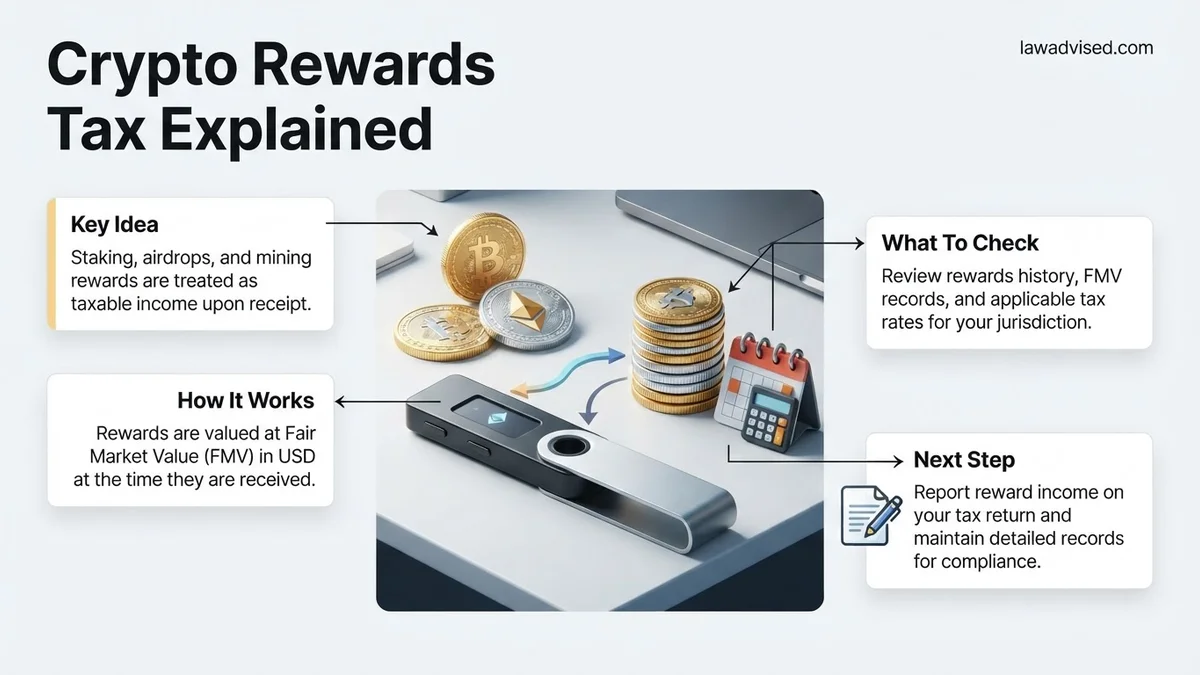
Crypto rewards are subject to a two-part tax system where you owe ordinary income tax the moment you receive them, followed by capital gains tax when you sell. Understanding fair market value and maintaining precise transaction records is essential to staying compliant with IRS guidelines.
Cryptocurrency rewards like staking, mining, airdrops, and interest are taxed as ordinary income based on their fair market value in US dollars the exact moment you gain dominion and control over them. You owe income tax on these rewards immediately upon receipt, regardless of whether you cash them out, hold them, or watch their value plummet later.
Navigating the tax rules for crypto rewards in 2026 requires strict attention to timing and valuation. This guide breaks down the dual-tax nature of crypto rewards: ordinary income upon receipt, followed by capital gains or losses when you eventually dispose of those assets.
Key Takeaways
- Crypto rewards are taxed as ordinary income based on fair market value at receipt.
- You gain dominion and control over rewards the moment they hit your wallet.
- Selling or trading rewards later triggers a separate capital gain or loss event.
- Your cost basis for future sales equals the USD value reported as income.
- Staking, mining, and airdrops all follow identical initial income recognition rules.
What Causes Crypto Rewards Tax Liability to Trigger
The Moment of Receipt and Dominion and Control
Tax authorities view the acquisition of crypto rewards the same way they view receiving a cash paycheck or physical property. The taxable event triggers the second the tokens land in your wallet or account and you possess the ability to transfer, sell, or trade them. If your staking pool or platform locks your rewards for a mandatory vesting period, your tax liability pauses until that lockup ends and you gain true dominion and control. For tax filing in 2026, you must log the exact fair market value in USD on the day and hour those rewards become accessible to you.
Tax Treatment Across Different Reward Types
While the triggering event remains the same for all rewards, the classification affects your record-keeping. Consider these operational categories:
- Staking Rewards: Taxed as ordinary income at the fair market value when credited to your staking address.
- Proof-of-Work Mining: Treated similarly to self-employment income, requiring you to track the exact minute minted coins hit your address.
- Airdrops and Hard Forks: Trigger ordinary income tax based on the USD value at the time you successfully claim and control the tokens.
- Crypto Interest and Yield Farming: Counted as ordinary income the moment interest payments accrue and become withdrawable.
How to Calculate and Report Crypto Rewards Step-by-Step
Establishing Your Cost Basis for Future Capital Gains
The fair market value you report as ordinary income on the day you receive your crypto rewards automatically becomes your initial cost basis. This distinction is critical because disposing of these rewards later creates a secondary tax event. If you receive 1 Ethereum as a staking reward when it is worth 3,000 USD, your cost basis is 3,000 USD. If you later sell that Ethereum for 4,500 USD, you trigger a capital gain of 1,500 USD. Conversely, if the price drops and you sell for 2,000 USD, you realize a 1,000 USD capital loss.
Actionable Reporting Workflow
To stay compliant and minimize your tax burden, implement a systematic reporting routine:
- Export transactional CSV files from every exchange, decentralized finance protocol, and self-custody wallet you use.
- Match every reward payout to its historical USD fair market value using a reliable pricing aggregator for that specific timestamp.
- Record these amounts as ordinary income on your tax software or schedule, making sure to categorize self-employment mining income correctly.
- Maintain a separate ledger for each reward token to track its individual cost basis for future capital gains or losses calculations.
What If Your Crypto Rewards Have No Market Value at Receipt
A common dilemma in digital asset taxation occurs when you receive obscure or newly launched tokens that lack immediate liquidity or exchange listings. According to cryptocurrency tax experts at the AICPA, income must be realized in US dollar terms at the exact moment of dominion and control. If a token has zero trading volume or market price on the day you claim your staking rewards, determining fair market value requires a defensible valuation methodology.
Step-by-Step Valuation Fallbacks
- Check secondary decentralized exchanges (DEXs) and liquidity pools where the token might trade, even with low volume.
- Reference the launchpad price or initial coin offering (ICO) price if the token was acquired directly through a protocol event.
- Consult professional crypto valuation aggregators that track historical on-chain pricing models for illiquid assets.
- Document your chosen valuation method thoroughly in your tax records to satisfy IRS disclosure standards in 2026.
Ignoring zero-value tokens entirely is a compliance risk. If the asset later appreciates and you sell it, the IRS may deem your original cost basis as zero, triggering a higher capital gains tax bill. Establishing a documented baseline protects you during an audit.
Proven Strategies to Fix Poor Crypto Tax Tracking Methods
Many investors rely on manual spreadsheets or exchange-generated 1099 forms, which frequently miss decentralized finance (DeFi) rewards, airdrops, and complex staking yields. Research from blockchain analytics firms indicates that over 40 percent of self-filers miscalculate their taxable crypto events due to fragmented wallet histories. Transitioning to a unified system prevents costly reporting errors.
Steps to Clean Up Your Crypto Tracking
- Audit all active self-custody wallets, hardware devices, and centralized exchange accounts used throughout 2026.
- Integrate a dedicated crypto tax software platform via read-only API keys to automatically pull historical blockchain transactions.
- Reconcile missing transfers between your own wallets to prevent double-counting taxable income events.
- Generate a comprehensive IRS Form 8949 and income report to review against your preliminary calculations.
Automated software significantly reduces discrepancies between actual blockchain data and reported tax figures. Modern tracking tools utilize advanced algorithms to match cost bases across multi-chain ecosystems accurately.
What If It Still Doesn’t Work?
If automated portfolio syncs fail due to obscure smart contracts, custom staking contracts, or corrupted blockchain history, manual intervention becomes necessary. Try these fallback steps to resolve persistent crypto tax discrepancies:
- Export raw CSV transaction logs directly from blockchain explorers like Etherscan or Solscan for manual ledger entry.
- Isolate problem wallets or unfamiliar smart contract interactions and analyze them token by token.
- Consult a certified public accountant (CPA) or enrolled agent who specializes in digital asset taxation.
- Expect professional crypto tax advisory fees to range from $500 to $2,500+ depending on transaction volume and portfolio complexity in 2026.
Conclusion
Navigating crypto rewards tax requirements demands precise record-keeping and timely valuation of all staking, airdrop, and yield farming income. Failing to report these digital assets correctly exposes investors to severe IRS penalties and inaccurate capital gains calculations. According to verified research and expert tax sources, adopting automated portfolio sync tools and adhering to strict valuation frameworks ensures complete regulatory compliance. Take the next step today by auditing your active crypto wallets and syncing them with a trusted tax platform to secure your 2026 financial reporting.
❓ Frequently Asked Questions
How does the IRS define dominion and control for crypto rewards?
Dominion and control means you have the ability to sell, trade, or transfer the cryptocurrency. For locked staking rewards, this occurs the moment the tokens unlock and become accessible in your wallet.
Do I have to pay self-employment tax on staking or mining rewards?
Mining rewards often require self-employment tax if conducted as a trade or business. Staking rewards generally do not trigger self-employment tax for standard retail investors, falling under regular investment income.
What is the difference between ordinary income and capital gains for crypto?
Ordinary income tax is applied to the fair market value of the crypto on the day you receive it. Capital gains tax is applied to any increase in value that occurs between the time you received the token and when you sold or traded it.
How do I calculate capital gains if I received hundreds of small staking payouts?
Each individual payout creates a separate tax lot with its own cost basis and acquisition date. Using specialized crypto tax software is typically required to automate this complex math accurately.
Are hardware wallet airdrops taxable if I didn’t ask for them?
Yes, if an airdrop is deposited into your wallet and you have the ability to access and control it, the IRS considers it taxable income regardless of whether you requested it.
What records should I keep for tax compliance on crypto rewards?
You should maintain records showing the date and time of receipt, the fair market value in USD at that exact moment, the transaction hash, and the wallet address used for the reward distribution.

Ismail Hossain is the founder of Law Advised. He is an Divorce, Separation, marriage lawyer. Follow him.